
Most beach club owners don't lose money because they priced an event wrong. They lose it because they quoted before settling the numbers underneath the quote: the cabana minimum, the deposit, the per-guest spend target, and what happens on a peak Saturday versus a soft Tuesday. This article works through the pricing questions that come up most often when operators build out beach club event revenue strategies, with direct answers first and the context that changes each answer after. If you're about to quote a buyout, a birthday booking, or a headline DJ date, start here.
How should a beach club price a cabana or daybed for events?
Price it as a spend commitment, not a rental fee. The strongest model is a food-and-beverage minimum attached to the seating, so the cabana pays for itself through consumption rather than a flat hire charge. A minimum does two things: it guarantees a revenue floor for that patch of floor, and it filters for groups who actually intend to spend.
The minimum itself should scale with three things: location on the floor (front-row and poolside carry premiums), day of week, and the demand on that specific date. A cabana that clears $500 on a Wednesday might justify $2,000 on a holiday Saturday with a booked headliner. Big-market dayclubs show how far this scales at the top end: according to the Las Vegas Review-Journal, megaclubs like Encore Beach Club and Tao Beach regularly post more than $1 million in revenue on a single peak Saturday, built almost entirely on tiered seating minimums.
One detail owners trip over early: what counts toward the minimum. Decide in advance whether tax, service charge, and premium bottles count, and put it in writing on the booking confirmation. A group that spends $1,800 against a $2,000 minimum and argues the service charge covered the difference is a door-line dispute waiting to happen. Most operators count food and beverage only, exclude tax and gratuity, and treat the gap as a checkout charge rather than an argument.
For smaller venues, the mechanism is identical even if the numbers are smaller. Set a base minimum per seat tier, then adjust by date. Configuring event table rules per date and per section is what makes this practical, because a spreadsheet version of "Saturday minimums are double" falls apart by the second weekend.
What deposit should we take when someone books an event?
Take enough to make cancellation sting, and take it at the moment of booking. For cabana and table reservations, that usually means 25 to 50 percent of the minimum up front, with the balance due before or at the event. For full buyouts and private events, the norm is a signed agreement plus a meaningful first payment, often half.
Deposits protect you twice. First, they cut no-shows, which are the quiet killer of event revenue because an empty prepaid cabana can't be resold at 4 p.m. Second, they convert soft intent ("we'll confirm next week") into committed revenue you can staff and stock against. A bar team ordering for 300 confirmed guests behaves very differently from one ordering for "300, probably."
Refund terms matter as much as the amount. A common working policy is non-refundable inside seven days, transferable to another date inside 30, and refundable outside that. Whatever you choose, state it at booking rather than at cancellation, when the guest is already disappointed and looking for a fight.
The friction point is collection, not the policy. Asking a guest to wire money or pay on arrival creates awkward conversations and slow closes. Operators using VenueStack collect deposits at the moment of booking through table deposit requests, so the commitment is made while the guest's enthusiasm is still warm. Whatever system you use, the rule is the same: no deposit, no held inventory.
How much should we charge per guest, and does it differ for ticketed events?
Anchor per-guest pricing to your actual per-guest spend data, not to what the venue across town charges. Pull your last season's average spend per head for comparable events (day party versus sunset session versus headline night), then set ticket prices and table minimums so a sold-out floor hits your target revenue with room for walk-ins.
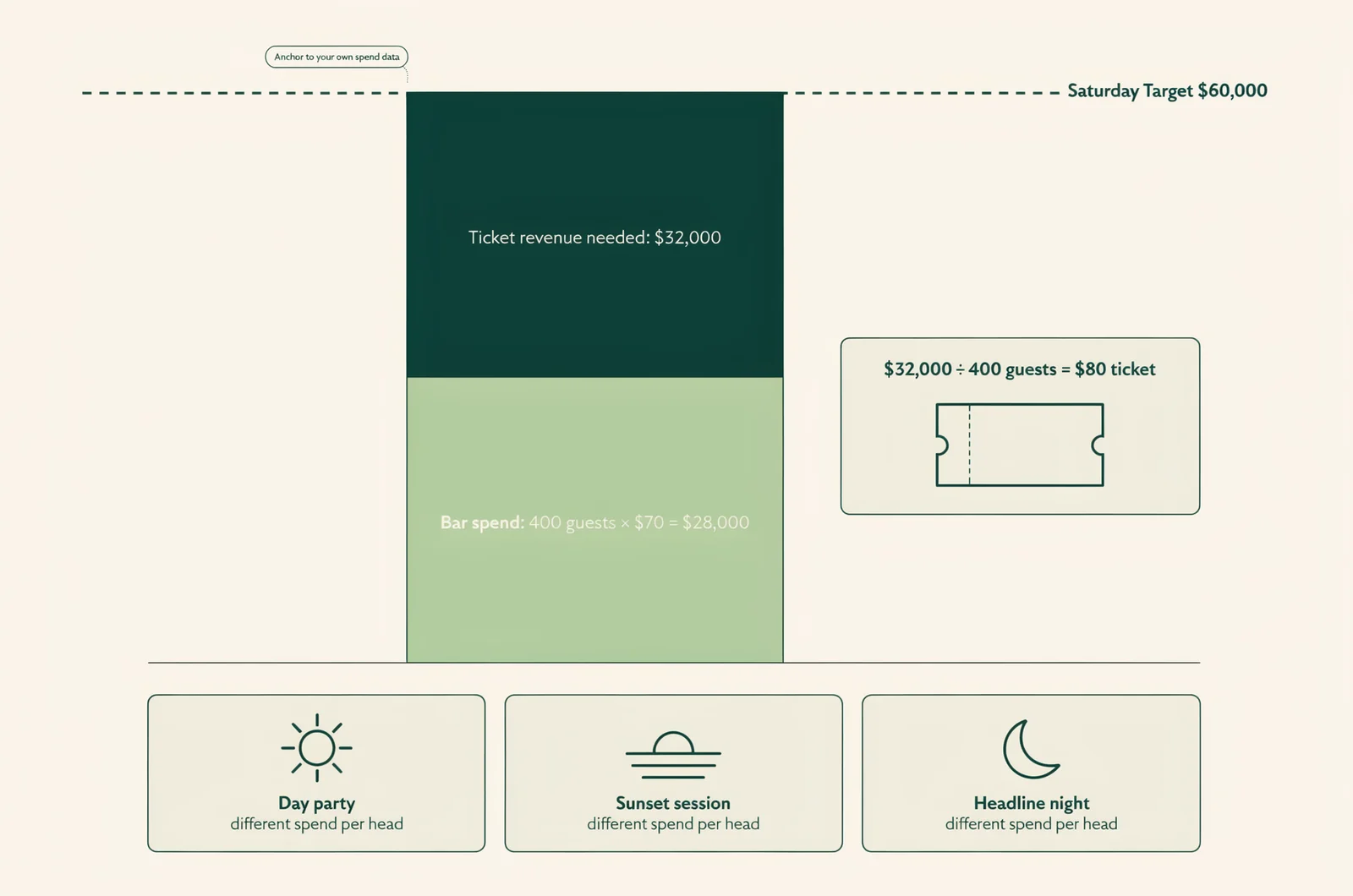
The math is worth doing on paper once. Say your floor holds 400 guests, your target for a Saturday is $60,000, and your historical spend per head at the bar is $70. Ticket revenue only needs to carry the difference between what the bar produces and the target, which tells you whether a $40 ticket or a $75 ticket is the honest price. Guessing the ticket first and hoping the bar covers the rest is how venues sell out and still miss the night.
For ticketed beach events, the common structure is tiered admission: early bird, general admission, and a premium tier that bundles entry with a bed or a drinks credit. Listings for events like Perrys Beach Club in Santa Monica show this pattern in the wild, where ticket tiers do the segmentation work that a door person used to do. Headliner dates justify a step up across every tier; when a name like Steve Aoki plays Palm Tree Beach Club, the ticket price is buying the artist as much as the venue.
One caution on ticketing economics: platform fees compound. If your ticketing provider takes a percentage of every sale, your busiest nights cost you the most in software. A flat-cost model keeps the per-guest margin intact when the event sells out, which is exactly when you want it.
How do we handle pricing for peak dates and holiday weekends?
Treat peak dates as a separate price list, published before anyone asks. The mistake owners make is quoting a standard minimum for July 4th weekend because the inquiry came in March and the rate card was open on the wrong page.
A workable structure:
- Base calendar. Standard minimums and ticket tiers for normal trading days.
- Peak overlay. Named dates (holiday weekends, headliner bookings, local festival weeks) with premiums set in advance, typically 1.5x to 3x base.
- Floor-based scaling. Within any date, front-row and pool-adjacent inventory prices above the back sections.
- Time-based release. Early-bird pricing closes on a fixed date, then steps up automatically.
Build the peak calendar once, before the season starts, with your events and reservations leads in the same room. The dates are usually obvious: every three-day weekend, any confirmed headliner, local festival and holiday weeks, and the last two Saturdays of the season in a seasonal market. Writing them down in advance also settles internal arguments later, because "is this a peak date?" stops being a judgment call made under pressure from a big-spending regular.
The reason this matters commercially is that peak dates carry the season. Las Vegas dayclubs generate $40 million to $70 million in annual revenue despite operating only six or seven months a year, per the Review-Journal's industry reporting, and that concentration means a handful of Saturdays do a disproportionate share of the work. Underpricing those dates is the most expensive quoting error a seasonal venue can make.
Should private events and buyouts be priced differently from regular programming?
Yes. Private events deserve premium pricing because they remove your ability to sell the same space twice. A corporate buyout on a Saturday doesn't just occupy the floor; it displaces whatever that floor would have earned from the public calendar.
Revenight's analysis of beach club business models notes that most beach clubs can command 20 to 40 percent premium pricing for private events, precisely because a flat fee plus an F&B minimum eliminates occupancy risk for both sides. The client gets certainty; you get a guaranteed number before the doors open.
When you quote a buyout, build it from three parts:
- A venue or space fee that reflects the displaced revenue, not just the room.
- A food-and-beverage minimum sized to realistic consumption for the headcount.
- Deposit and payment milestones tied to dates (booking, 30 days out, event day).
Partial buyouts deserve the same discipline. If a client wants the pool deck but not the restaurant, price the deck against what it would earn on its own that day, and protect a path for walk-ins through the rest of the property. A "half buyout" that quietly blocks your best door flow costs more than the client paid.
If the client balks at the premium, the fallback isn't a discount. It's a worse date. Offering Tuesday at standard rates preserves your Saturday pricing integrity and often lands the booking anyway.
What fills the calendar on soft days without discounting the brand?
Programming, not price cuts. The clubs with the strongest summer economics build a house event calendar that drives volume on traditionally quiet days, according to Private Club Marketing's peak-season analysis: twilight dinners, wine tastings, family programming, crossover events with other parts of the property. These aren't amenities. They're revenue engineering aimed at Tuesday through Thursday.
The discount instinct is understandable but expensive. Cutting your cabana minimum in half on a slow Wednesday teaches your best guests to wait for slow Wednesdays. The better move is to add a reason to come that only exists on that day, then keep pricing consistent. A chef-collaboration dinner or a guest DJ set costs less than the margin you give up with across-the-board discounts.
Venues in seasonal markets apply the same logic before the season even opens. Memberships and pre-season packages, like the kind Saadiyat Beach Club promotes in its seasonal offers, pull revenue forward and fill the soft shoulder weeks with committed guests rather than hopeful walk-ins. The pre-season version of this is worth real money: a membership or season-pass program sold in the spring turns your quietest revenue month into one of your best, before a single chair hits the sand.
How do we know if our event pricing is actually working?
Measure three numbers after every event, and compare them against the same day-type from prior weeks: revenue per available seat (or per cabana), spend per head, and the ratio of prepaid revenue to door revenue. If prepaid share is climbing, your pricing and deposit policies are doing their job. If spend per head is flat while minimums rise, you're charging more for the same experience, and guests will notice before your accountant does.
The operators who catch pricing problems early are the ones who reconcile the same night or the next morning, not at month's end. VenueStack's reporting pulls sales, check-ins, and table performance into one view, so the morning-after review takes minutes instead of a spreadsheet rebuild. However you do it, the discipline matters more than the tool: every event closes with a number, and every number gets compared to a baseline.
Two reporting traps to avoid. First, blended averages: a Saturday headliner and a Tuesday lounge session in the same average tells you nothing about either. Segment by day-type, event format, and seating tier, or the data will flatter your worst nights and hide your best ones. Second, gross revenue without capacity context: a $50,000 night at 60 percent capacity is a stronger signal than a $60,000 sellout, because the first one has headroom you can price into next time.
What should we settle before sending any quote?
Before a number leaves your inbox, confirm these in writing, even if just internally:
- The date's tier (base or peak) and the floor section being offered.
- The minimum, what counts toward it, and what doesn't (tax, service charge, outside vendors).
- Deposit amount, due date, and refund terms.
- The capacity implication: does this booking displace other sellable inventory?
- Tax handling for the event, which varies by state; Michigan, for example, requires a separate sales tax return for special events, so confirm how your jurisdiction treats one-off event sales.
A simple quoting calculator helps here more than most operators expect: date tier, seat tier, headcount, minimum, deposit, and projected spend in one place, so every quote your team sends reflects the same logic. It doesn't need to be fancy. It needs to be consistent, because consistency is what protects your peak-date pricing when a regular asks for a favor.
Pricing questions like these sit inside a broader set of decisions about how the floor, the door, and the numbers connect. The beach club management software page shows how VenueStack handles cabanas, table minimums, deposits, and event sales in one system, and the pricing and setup FAQ covers the logistics owners usually raise next.
Keep building your pricing playbook: