
A good event deposit refund policy does two jobs at once. It protects your revenue when a table cancels the week before a big night, and it reads fair enough that guests sign it without calling a manager over. Most venues have neither. They have a vague line in a confirmation email ("deposits are non-refundable") that collapses the first time someone pushes back, or a chargeback lands. This walkthrough takes you from a blank page to a finished, signable policy: which deposits to hold, how to tier refunds by days out, what to say about no-shows and reschedules, and where the text lives in your booking flow so it's agreed to before a card is charged.
You don't need a lawyer to draft the working version. You need about an hour, your real cancellation numbers, and the plain-language structure below. Have an attorney review the final wording if you operate in multiple states or hold large five-figure event deposits.
What you're building and what you need before you start
The end product is a single document, roughly 300 to 500 words, that answers five questions in numbers and deadlines rather than adjectives:
- How much is the deposit, and what does it reserve?
- How much comes back if the guest cancels, by how many days out?
- What happens if the guest simply doesn't show?
- What happens if the guest reschedules?
- When and how is any refund paid?
Before you write a word, pull three numbers from your own operation: your average no-show or late-cancellation rate, the revenue a cancelled table or cabana actually costs you on a typical night, and the furthest-out booking window you allow. These set your tiers. If you don't have clean numbers, run a month of tracking first; a policy built on guesses either gives money away or gets argued down at the door.
One constraint worth stating up front: the policy only protects you if the guest saw it and agreed to it before paying. Non-refundable deposits are broadly legal for US event vendors, but whether you actually keep one depends almost entirely on how the clause is written and when it was disclosed. A policy page nobody sees until the dispute email is worth nothing in a chargeback. So the drafting work and the placement work in this guide are equally important.
Step 1: Decide what each deposit actually reserves
Start by writing one sentence per deposit type that says what the money holds. This sounds obvious, but it's the clause that wins arguments later. "Deposit reserves the date" is enforceable logic: you turned away other bookings for that slot, so the deposit compensates you for the empty space. "Deposit is a fee" is not.
Most hospitality venues need two to four deposit types, not one blanket rule:
- Table or cabana minimum deposits. Common in nightclubs, lounges, and beach clubs. The deposit reserves a specific table or daybed and usually applies toward the night's spend.
- Group or large-party deposits. Often per person ($20 to $35 a head is a common range for group bookings) to stop one organizer from holding three tables "just in case."
- Private event and buyout deposits. Larger sums, longer lead times, and the tier most likely to need a formal contract attached.
- Holiday and special-event deposits. New Year's Eve, big fight nights, festival weekends. Guests already expect to commit money for these dates, so you can hold more.
For each type, write the sentence in guest-facing language: "Your $500 deposit reserves Cabana 6 for Saturday, June 20, and is credited toward your final bill." That last clause matters. Deposits that apply toward the spend feel fair and are defended more easily than deposits that vanish into the house.
If you run tables and cabanas through nightclub table management or beach club software, you likely already have these deposit types configured as inventory. The policy document is just the written version of what your floor plan already enforces.
Step 2: Build refund tiers by days out
This is the heart of the policy. A single "non-refundable" line is lazy and brittle; a graduated schedule is what actually survives a guest argument, because the guest can see the logic. The pattern across the events industry is consistent: the closer to the date, the more you keep, because your odds of rebooking the slot fall.
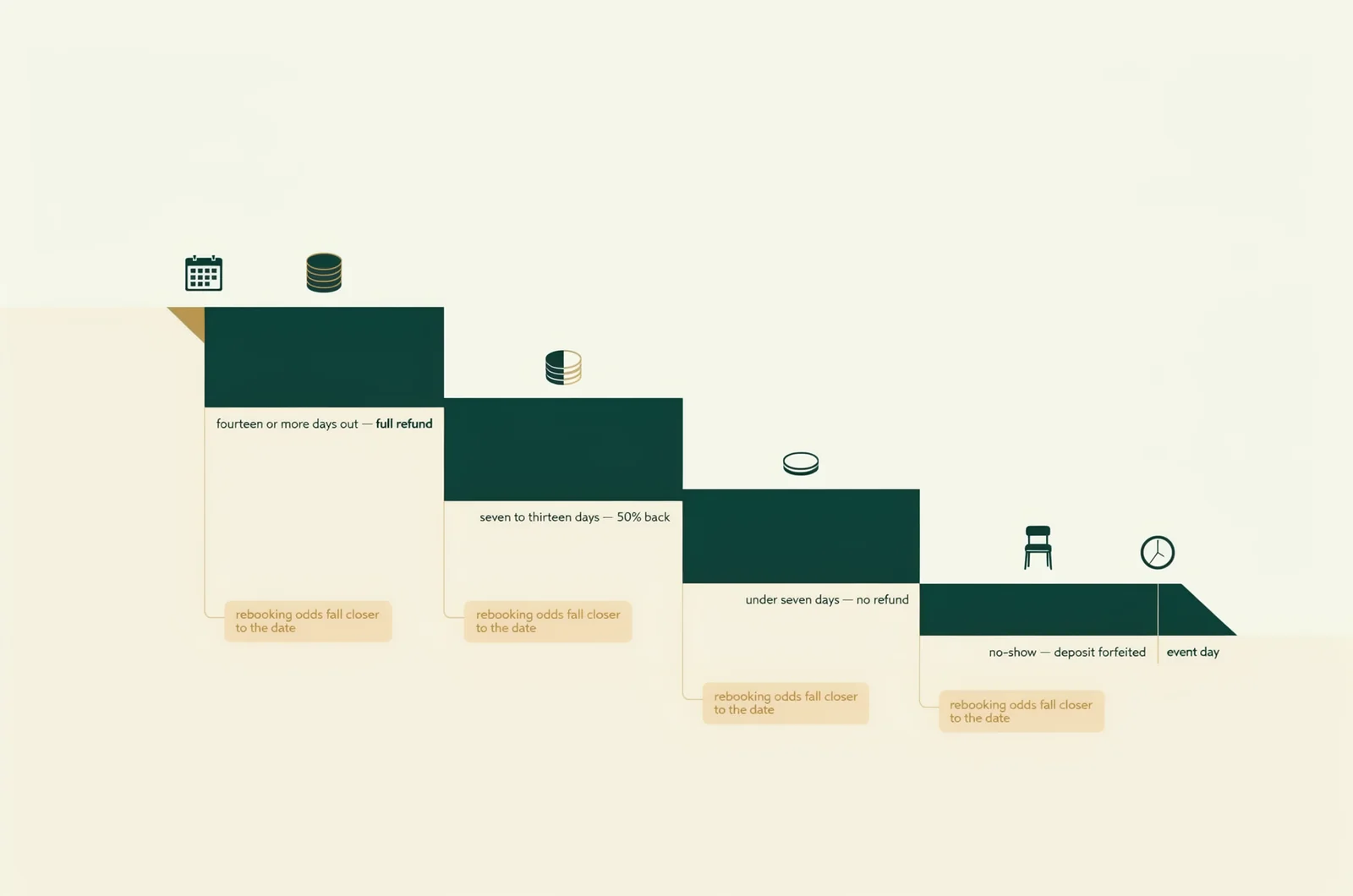
Here's a starting framework for tables, cabanas, and private events. Adjust the windows to your booking cycle:
| Days before the event | Guest gets back | Why it holds up |
|---|---|---|
| 14+ days | 100% | Slot rebooks easily; keeping anything looks punitive |
| 7–13 days | 50% | Rebooking is possible but not guaranteed |
| 48 hours–6 days | 0% (deposit kept) | You've almost certainly lost the revenue |
| Under 48 hours / no-show | 0% plus any agreed no-show fee | Full loss; card was held for exactly this |
For private events with real hard costs (staffing booked, product ordered), stretch the windows. Catering and event vendors commonly run 90/60/30-day schedules, keeping a larger share as the date approaches and costs commit. The party rental deposit policy template from Eventodesk and Qwilr's guide on structuring deposits in event proposals both follow this graduated shape, and venue operators writing about deposit strategies that protect revenue land on the same logic: tie each tier to a real, explainable cost.
Write the tiers into the policy as a short list, exactly like the table above. Numbers and dates, not "a reasonable cancellation fee." Vague terms are the ones that get refunded in full after a dispute.
Verification cue: read your tiers as if you were the guest cancelling 10 days out. If your honest reaction is "that's fair," the tier is right. If it's "they kept everything for a 10-day cancellation?", soften that tier.
Step 3: Write the no-show and reschedule clauses
No-shows and reschedules are different animals and need separate clauses.
No-shows. State plainly that a guest who neither cancels nor arrives forfeits the full deposit, and name any no-show fee you'll charge to the card on file. The enforceability hinge is disclosure: the guest agreed to this before paying. Restaurants running reservation deposits follow the same three-way split — deposit applies to the bill if the guest shows, refunds inside the cancellation window if they cancel properly, forfeits if they ghost. That structure works because it's easy to explain at the door.
Reschedules. Decide whether a reschedule is a cancellation (tiers apply) or a transfer (deposit moves to the new date). Most venues do better with the transfer rule: one free date change outside a cutoff (say, 7 days), then the cancellation tiers kick in. It keeps the booking, keeps the goodwill, and still protects you from serial movers. Spell out how far the new date can be pushed — "within 60 days of the original date, subject to availability" is a workable line.
Your side of the table. Guests will ask what happens if you cancel: double-booking, a private buyout that displaces their table, a closure. Answer it in one sentence — full deposit back within a stated number of days — and the whole policy reads as a two-way agreement rather than a trap. That symmetry is what makes people sign without negotiating.
Step 4: Add the refund mechanics sentence
Most policies stop at "refundable" and never say how or when. That's where disputes actually start. Add one mechanics sentence covering three things:
- Timeline. "Refunds are processed within 7 business days of the cancellation." Planners who write deposit clauses for a living push for explicit deadlines, sometimes with interest accruing on late refunds, precisely because vague timelines stall. Pick a number you can hit and commit to it.
- Method. Refund to the original payment method. This is also how card networks expect disputes to resolve, and it's how your ticket order refunds and pass refund process work in practice if you process payments through VenueStack — the money goes back down the rail it came in on.
- Deductions. If any non-refundable processing cost comes off the top, name it as a number, not a percentage surprise.
For ticketed events rather than table deposits, check your platform's baseline rules too. Eventbrite, for example, publishes organizer refund policy requirements that set a floor for cancelled and postponed events — your house policy can be stricter about guest cancellations, but a full event cancellation owing refunds is a different legal situation, and state rules increasingly set hard deadlines (California law, for instance, requires full refunds within 30 calendar days of a cancelled event). For sample legal phrasing on the cancellation side, Law Insider's collection of deposit and cancellation policy clauses shows how the graduated structure looks in actual contracts.
Step 5: Write the plain-language version and cut the legalese
Now assemble the document. The working structure:
- What the deposit reserves (Step 1)
- Cancellation tiers (Step 2)
- No-show terms (Step 3)
- Reschedule terms (Step 3)
- If we cancel (Step 3)
- How refunds are paid (Step 4)
Keep sentences short and second-person: "If you cancel 8 or more days before your reservation, we refund your full deposit." Read it out loud. If a sentence sounds like it came from a lease, rewrite it. The test is whether your newest host could explain the whole policy at the door in 30 seconds without notes.
Length check: under 500 words. A policy that fits on one phone screen gets read; a 2,000-word terms page gets scrolled past, and "they didn't read it" is a harder argument to win than "they checked the box under a 400-word summary."
If you want to pressure-test your tiers before publishing, a small spreadsheet or calculator that models "deposit kept vs. rebooking probability by days out" against your last quarter's cancellation data is a genuinely useful internal tool — it shows you the revenue each tier protects and the goodwill each refund costs, in dollars.
Step 6: Put the policy where guests agree before paying
The finished text needs to live in three places, in this order of importance:
In the booking flow, before payment. A checkbox ("I agree to the deposit and cancellation policy") with the full text linked or expanded inline. This is the agreement record that wins chargebacks. If you take bookings through your own site, your reservation widget setup should place the policy text at the payment step, and when staff take a booking by phone they should send the policy link before collecting card details — the deposit request feature flow makes that a natural moment, since the guest receives the deposit request and the terms together. VenueStack venues collect deposits inside the same booking flow where the policy is displayed, so the agreement and the payment timestamp sit in one record instead of two systems you have to reconcile after a dispute.
In the confirmation. Repeat the two sentences that matter most: what was reserved, and the next tier deadline. "Your $300 deposit reserves Table 12 for Saturday. Cancel by midnight Thursday for a full refund; after that the deposit is non-refundable."
At the door and on the phone. Train staff on the 30-second version. A policy is only as good as the person who has to say it to an angry guest at 11:45 p.m. If the wording keeps producing awkward conversations, that's a drafting problem, not a staff problem — the guide on handling the awkward deposit conversation covers the framing side of this in more depth.
Step 7: Test it against your worst recent disputes
Before publishing, run the draft against the last five deposit arguments you actually had. For each one, find the sentence in the new policy that would have settled it, and note where the agreement would have been recorded. Any dispute the policy can't answer is a gap — add a clause. Any dispute where the clause exists but you have no proof of agreement is a placement problem — go back to Step 6.
Then do one live test: book a table yourself through your own flow, on a phone, and confirm the policy appears before the card field, the checkbox is required, and the confirmation email restates the key deadline. If any of those fail, fix the flow before the policy goes live.
Questions operators ask about deposit policies
How much should I charge as a deposit? Enough to change behavior without scaring off real bookings. For tables and cabanas, 20–50% of the expected minimum spend is a workable band; group bookings often run $20–35 per person; holiday and special-event dates can hold the full minimum. If your no-show rate doesn't drop within a month, the number is too low.
Is a non-refundable deposit actually enforceable? Generally yes in the US, provided the terms were clearly disclosed and agreed to before payment, and the amount bears some relationship to your real loss from the cancelled booking. A deposit kept for a cancellation 45 days out, when you rebooked the slot the same week, is the kind of case that loses in a dispute. Graduated tiers are both fairer and more defensible.
Should the deposit apply to the final bill? For tables and cabanas, yes — it converts the deposit from a "fee" into a commitment device, which guests accept much more readily. For private events where the deposit covers real planning costs, crediting part of it and treating the rest as a booking fee is common; just say which is which in writing.
What if a guest disputes the charge anyway? Respond with three artifacts: the policy text as displayed at booking time, the timestamped checkbox or agreement record, and the confirmation message restating the deadline. That bundle is what card networks ask for, and it's why Step 6 matters as much as the wording.
How often should I revisit the policy? Twice a year, or any time your cancellation pattern shifts — a new competitor, a season change, a move from walk-ins to reservations. Update the tiers, re-publish, and re-prompt agreement on new bookings. Old bookings stay under the version they agreed to.