
Your venue software contract renews in a few weeks or months, and the honest question is whether you should sign again. Most operators never answer it properly. They glance at the invoice, remember one bad Saturday, and either renew out of inertia or switch out of frustration. This guide gives you a third option: a structured pre-renewal audit of your nightclub management software that scores ticketing, table reservations, guest list, check-in, and reporting in one pass, then lands you on a verified decision — keep, renegotiate, or replace.
The audit takes about three hours spread across one operating week. You need four things before you start: your current contract and pricing schedule, admin access to every tool you pay for, door and sales data from your last four busy nights, and one staff member who actually works the door. Do not start without the door person. The gap between what a platform promises and what the door experiences at 12:30 a.m. is where most of the useful findings live.
Why a structured audit beats gut feel
The market has moved fast enough that last year's reasonable choice may be this year's overpayment. The global bar and nightclub tech market hit roughly $3.7 billion in 2025 and is forecast to reach $7.1 billion by 2033, according to HTF MI data cited in a 2026 nightclub software roundup. The broader club management software market is valued at about $9.1 billion in 2026, per one buyer's guide on club platforms. Growth like that means vendors are repricing, re-tiering, and acquiring each other constantly. Your renewal terms may not match what new customers pay, in either direction.
There is also a consolidation trend working in your favor. Venues that once ran separate tools for ticketing, table bookings, guest lists, and CRM are increasingly folding those functions into one platform. A 2026 industry piece on live entertainment tech describes platforms now covering functions that previously required separate vendors: at-door ticketing and payments, CRM and floorplan management, and more. If you are still paying three vendors for what one platform now does, the audit will surface that overlap in dollar terms.
The timing matters too. TouchBistro's 2026 State of Restaurants report found that 74% of operators plan to spend more on technology in the coming months, but that they are evaluating each tool more carefully than before. You are not alone in doing this homework, and vendors know renewal season is negotiation season.
Step one: build your real cost baseline
Pull every line item you paid over the last twelve months for anything that touches the guest journey before, during, or after a night out. That usually means a ticketing tool, a table reservation tool, possibly a guest list app, a CRM or email tool, and any promoter tracking spreadsheet you maintain by hand. Add the monthly fees, per-ticket fees, percentage-of-sales cuts, setup fees you amortized, and the payment processing markup if your vendor controls the processor.
The percentage-of-sales model deserves special attention because it hides in plain sight. A platform charging 5% of ticket revenue feels cheap in January and punishing in December. Run the math on your four busiest nights of last year: take gross ticket sales, multiply by your platform's percentage, and compare that figure to what a flat-fee tool would have cost for the same nights. Operators who do this exercise regularly find the busy-night penalty runs into four figures per month during peak season. If you want a head start on which ticketing models avoid this, there is a breakdown of ticketing platforms without sales cuts worth reading alongside your invoice.
Verification cue: when you finish, you should have one number — total annual software spend on the guest journey — and a second number showing what share of it scales with your revenue. Write both down. The second number is your renegotiation ammunition.
A useful shortcut here is a simple cost estimator: plug in your average monthly ticket revenue, your platform's percentage cut, and the flat monthly fee of any alternative, and it outputs your twelve-month difference. Even a spreadsheet with three cells does the job, and it turns an abstract pricing complaint into a specific dollar figure for the renewal call.
Step two: score the five functional areas
Now grade what you actually get for that money. Score each area from 0 to 2: 0 means broken or missing, 1 means it works with workarounds, 2 means it works the way your night actually runs. Have your door person score check-in independently, then compare scores. Disagreements between office scores and door scores are findings, not arguments.
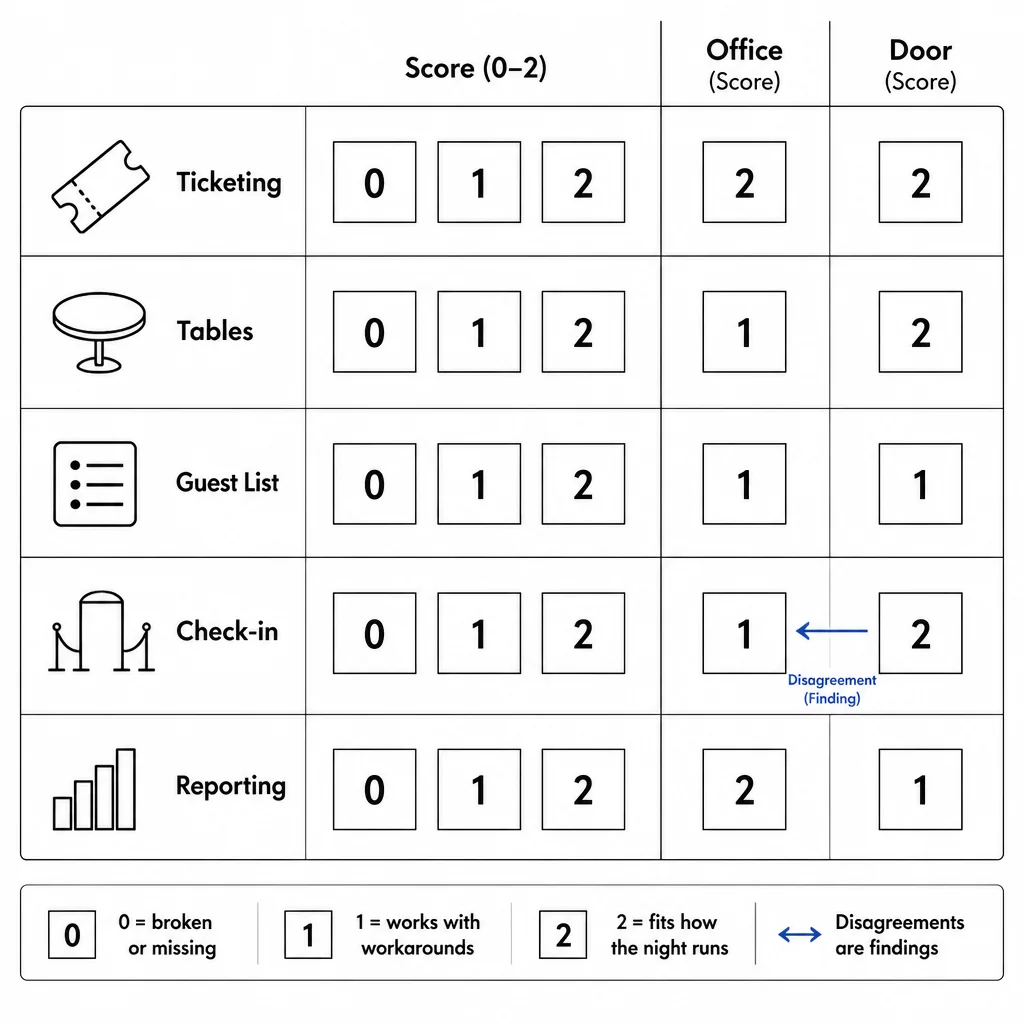
Ticketing
Test the full loop: create an event, sell a presale ticket, refund one, and check the payout timing. Confirm whether tickets and tables can live in the same event or need separate listings. Check the fee structure again here, because some platforms quote a low monthly rate and recover it through per-ticket fees your guests absorb. Look at whether ticket buyers land in a customer database you own or in the platform's marketplace. Ticket Fairy's nightclub ticketing software page, for example, positions venue and guest management as one system, which is the direction the category has moved — worth knowing when you benchmark your own setup.
Table reservations and deposits
Create a table booking with a deposit, move it to a different section, then cancel it. If any of those three actions requires a phone call to support or a manual refund outside the system, that is a 1 at best. Confirm the floor plan is editable by your staff, not just the vendor — drag-and-drop floor plans and per-section pricing have become standard expectations, as seen in how TablelistPro describes its platform. Double-booking protection is the pass/fail test: try to book the same table twice and see whether the system stops you.
Guest list
The guest list question that matters most is ownership. Export your full guest list right now. If you cannot get names, contact details, and visit history out in a usable format within ten minutes, your list belongs to the vendor, not to you. That changes your negotiating position dramatically, because leaving the platform means leaving your regulars behind. Also check whether list guests, ticket buyers, and table bookers merge into one guest profile or sit in three silos. A single guest profile is what lets you see that the person on tonight's comp list also spent $900 on a table last month.
Check-in and door flow
This is the step where you use the busy-night data. From your last four Saturdays, note peak entry volume per hour and count how many devices were scanning at peak. Then test the check-in flow offline: put a device in airplane mode and scan ten test tickets. Some platforms stall or lose counts without connectivity, which is exactly what happens in a concrete-walled venue at 1 a.m. Confirm the door can handle mixed entry — presale tickets, guest list names, table arrivals, and walk-up cover — from one screen rather than switching apps. QR-based check-in across tickets and guest list is now common across nightlife platforms; Nightsquare's organizer platform and others treat it as table stakes, so a platform that cannot do it is behind the category.
Verification cue: your door person's scorecard should show every 0 and 1 with a concrete example attached — "lost count during the 12:45 rush," "couldn't find the table booking without calling the office." Vague complaints do not survive a vendor negotiation; specific ones do.
Reporting and the morning after
Run the report you would want on a Sunday morning: total revenue split by tickets, tables, and door; attendance against capacity; no-show rate on deposits; and per-promoter sales. Time how long it takes. If the answer involves exporting three CSVs and a spreadsheet, your reporting is a 1. Some platforms now automate this entirely — automated venue reporting is a selling point across the 2026 platform comparisons precisely because manual reconciliation is so common. For a reference point on what a connected report looks like, VenueStack's table reporting features documentation shows the level of detail you should expect without exports.
Step three: check what your tier actually includes
Pricing tiers are where renewals quietly get worse. List every feature your team uses weekly, then mark which pricing tier each one sits in on your vendor's current public pricing — not the tier structure from when you signed. Vendors reshuffle tiers, and features you had at launch sometimes migrate upward at renewal.
Pay attention to three common lock patterns. First, reporting depth: basic dashboards on the entry plan, real analytics behind an upgrade. Second, API or export access, which gates whether your data can flow to accounting or marketing tools. Third, multi-user or multi-device limits, which punish you for staffing the door properly. Cross-check your list against what competitors bundle. SevenRooms, for instance, sells its nightclub CRM and operations solution with marketing and guest data in one package, while other vendors charge separately for the CRM layer. Neither model is wrong, but you should know which one you are paying for.
If your audit shows you use six features and three of them sit above your current tier, the renegotiation conversation writes itself: bundle those features at your renewal rate, or you walk with the scorecard in hand.
Step four: run the keep, renegotiate, or replace decision
Total the five functional scores. Ten is a perfect platform; treat anything seven or above as keepable, four to six as renegotiate territory, and three or below as replace.
For a keep decision, still send the audit to your account manager. Vendors rarely volunteer loyalty pricing, but they respond to documented usage. Ask for the percentage cut to be capped or converted to a flat fee, citing your twelve-month baseline from step one.
For renegotiate, lead with the tier-locked features and the busy-night percentage math. Anchor on a specific competitor price for the same scope. The SERP for this category is full of platforms — Guestii's nightlife venue software, RealTime Reservation's nightclub offering, and others — so credible alternatives exist at every budget, and your vendor knows it.
For replace, the audit becomes your migration spec. The scores tell you exactly which capabilities a new platform must prove in a demo: same-night tickets and tables, editable floor plans, exportable guest data, offline check-in, and morning-after reporting without spreadsheets. When you reach that stage, it is worth seeing how a unified venue platform handles the full loop in one account — VenueStack runs ticketing, table bookings, deposits, guest lists, and check-in as one connected system with flat pricing, which is the model this audit tends to point operators toward. Whatever you shortlist, insist on a data export test from your old platform before you sign anything new, and keep the old account live through one full weekend after cutover.
One warning before any switch: confirm notice periods. Many venue software contracts auto-renew with 30 to 90 days' notice. If your renewal date is inside that window, send a notice of intent to renegotiate in writing today, even if you have not decided. It preserves your options and costs nothing.
Questions operators ask before renewing
How long does the audit take if my tools are fragmented? Longer on data collection, shorter on scoring. Fragmented stacks make step one painful because invoices come from three vendors, but they make step four obvious, because consolidation usually wins on cost alone. Budget an extra hour to hunt down contracts.
What if my door staff and my office disagree on scores? Weight the door score higher for check-in and guest list, and the office score higher for reporting and setup. Then investigate any area where scores differ by two points — that gap usually means a feature exists on paper but fails under load.
Should I audit even if I just signed last year? Yes, but a lighter version. Run steps one and two only, and use the results to build your case file for next year's renewal. Multi-year contracts often include annual price escalators, so knowing your real cost trajectory matters more than the sticker price.
Is percentage-of-sales pricing ever the right choice? It can work for venues with low, steady ticket volume where the platform's marketing reach drives real incremental sales. It stops working the moment your own reputation is what sells the tickets. At that point you are paying a tax on your own demand.
What should a replacement demo actually cover? Skip the slideware and ask the vendor to run your four failure scenarios live: a double-booking attempt, an offline scan test, a deposit refund, and a Sunday-morning report build. Fifteen minutes of that tells you more than any feature list.