




Skip to content

City guides

Running a bar or club in Glasgow.

When service ends, how a premises licence and a personal licence are won, what the bill and the team cost, and the nights that fill the city, for anyone running a club, lounge or bar here.

Amounts in GBP

Glasgow at a glance

Standard hours
MidnightCity-centre pubs to 1 a.m., clubs to 4 a.m.
Challenge 25
25Written into every premises licence
VAT
20%Compulsory service charges included
National Living Wage
£12.71/hAge 21 and over, from April 2026
Minimum unit price
65p/unitApplies to bar sales too
Overprovision
13localitiesPresumption against new licences

Nightlife in Glasgow.

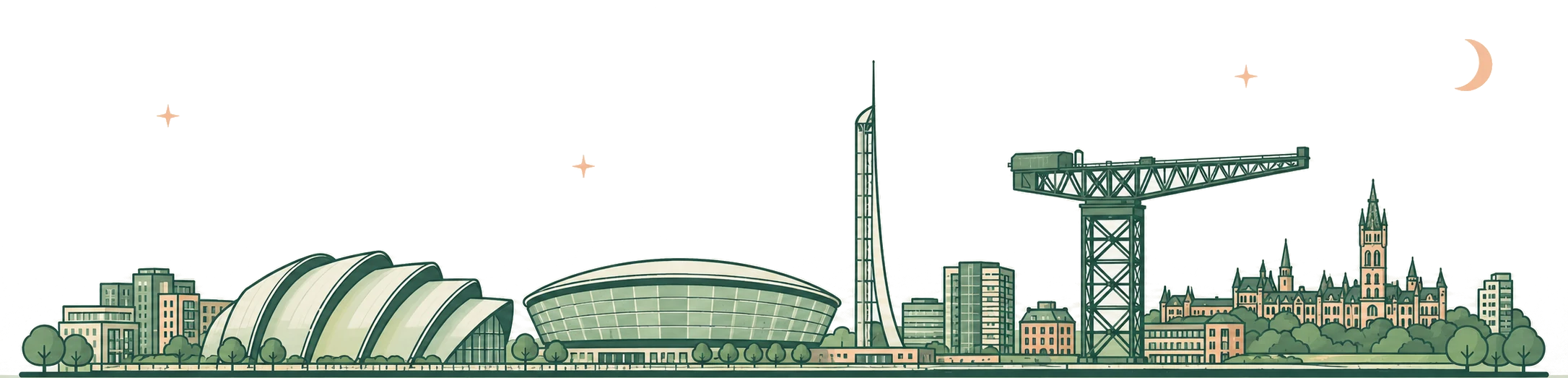
Glasgow’s nights run along Sauchiehall Street, around the Merchant City, in the city centre, the West End, Finnieston and the East End. The Licensing Board sets standard on-sales hours of 11 a.m. to midnight, lets eligible city-centre pubs and bars apply for 1 a.m., and generally allows city-centre nightclubs to open until 4 a.m. Thirteen localities carry a presumption against new licences. Hogmanay, Halloween and Burns Night anchor the calendar, and the Board’s festive period adds an extra hour for city-centre venues from late November to early January. The city has 654,000 residents, 30.2% of them aged 20 to 34. For an operator, the licence decides the night, and hours, premises manager, trained staff and Challenge 25 all follow from it.

Glasgow bar rules: closing time, licences and noise.

What the Licensing (Scotland) Act 2005 and the City of Glasgow Licensing Board ask of a licensed room, from closing time to the door. Liquor licences come from the Glasgow City Licensing Board.

The night, by the clock6 p.m. to 4 a.m.
  • Standard on-sales hours
    • 6 p.m. to Midnight Sale and service to midnight
    • Midnight to 1 a.m. City-centre pubs, by variation
    Source: Board policy
  • Outdoor areas
    • 6 p.m. to 10 p.m. To 10 p.m.
    Source: Board policy
  • Late-opening premises
    • Midnight to 2 a.m. Outside the centre
    • 2 a.m. to 3 a.m. City centre
    Source: Board policy
  • Nightclubs, city centre
    • Midnight to 4 a.m. Generally to 4 a.m.
    Source: Board policy

These are the Board’s policy hours; the hours that apply to a venue are the ones in its operating plan. Dashed hours need a premises licence or variation that grants them. The Board’s festive period adds an hour.

Staff and the door

  • Staff training

    2 hours

    Everyone who sells or serves alcohol, except personal licence holders, needs at least 2 hours of training from a personal licence holder or an SQA-accredited provider.

    More

    It covers 16 topics, from the licensing objectives and licensed hours to proof of age, test purchasing, units of alcohol and conflict management.

    Source: legislation.gov.uk
  • Personal licence

    5 years

    A personal licence holder must show the Board evidence of the prescribed training within 3 months after each 5-year period. If not, the Board must revoke the licence.

    More

    It is also what your premises manager must hold. The application fee is £50.

    Source: legislation.gov.uk
  • Premises manager

    Personal licence

    A personal licence is required by anyone who will be the designated premises manager of licensed premises in Scotland.

    More

    Glasgow has four Licensing Standards Officers, and the Board weighs their reports when deciding on later hours.

    Source: Glasgow City Council
  • Door staff

    SIA licence

    You need an SIA door supervisor licence to guard licensed premises against damage, theft, unauthorised access or disorderly behaviour.

    More

    Licensed premises means a venue licensed to sell alcohol for drinking on the premises or to provide regulated entertainment.

    Source: GOV.UK (SIA)
  • Challenge 25

    25

    Every premises licence must have an age verification policy: staff must establish age when a customer may be under 25, or an older age the policy sets.

    More

    Venues selling alcohol for drinking on the premises must also display an A4 sign saying whether under 18s are allowed.

    Source: legislation.gov.uk

The room

  • Late-opening conditions

    250+

    A room that holds 250 or more and regularly offers music above 85 dB, dancing or adult entertainment between 1 a.m. and 5 a.m., or has more customers standing than seated, must have a first-aid trained person present from 1 a.m. and a personal licence holder as a designated person.

    More

    Check your capacity against the threshold before you apply for late hours.

    Source: legislation.gov.uk
  • Martyn’s Law

    200+

    A building mainly used for a listed purpose, where 200 or more people can be expected at once from time to time, staff included, is likely in scope. The Act is expected to start in spring 2027.

    More

    The SIA is the regulator and final guidance is due in autumn 2026. It applies across the UK.

    Source: GOV.UK (SIA)

Hours, permits and supply

  • Standard hours

    11am to midnight

    The Board’s standard hours for on-sales premises are 11 a.m. to midnight, every day. Outdoor areas stay at 10 p.m.

    More

    Hours are written into the operating plan of the premises licence, and the Board treats later hours as an exception to this standard.

    Source: Board policy
  • City-centre pubs and bars

    1 a.m.

    Eligible city-centre pubs and bars can apply by major variation for a 1 a.m. terminal hour, which suits premises with under 75% of the floor given to full restaurant facilities.

    More

    The Board also weighs Best Bar None membership, complaints history, staff training and transport home, dispersal, CCTV, written safety policies and reports from the police and Licensing Standards Officers.

    Source: Board policy
  • Nightclubs

    4 a.m.

    Premises that mainly operate as a nightclub will generally be allowed to open until 4 a.m. in the city centre.

    More

    The Board looks at CCTV and stewarding, first aid, search and vulnerable-customer policies, how much dance floor there is after midnight and complaints. Where a DJ is the entertainment, one DJ plays live on equipment that mixes at least two tracks, with monitor speakers.

    Source: Board policy
  • Late-opening premises

    3 a.m.

    Venues that generally open only from late evening to early morning may get 3 a.m. in the city centre and 2 a.m. elsewhere, but not normally if they sell alcohol routinely before 7 p.m.

    More

    Alcohol must be ancillary to another substantial entertainment, such as dancing. Food, table meals and karaoke don’t count.

    Source: Board policy
  • Extended hours

    10 days

    The Board does not think it appropriate to grant extended hours on more than 10 days in each calendar year, on top of the festive policy days.

    More

    An application costs £10 and needs a substantial entertainment tied to the event. It can last up to a month for a special event or occasion.

    Source: Board policy
  • Overprovision

    13 localities

    Thirteen localities carry a presumption against granting premises licences, provisional licences and potentially variations: Bridgeton; Calton and Gallowgate; Carntyne West and Haghill; Govan and Linthouse; Ibrox; Keppochill; Laurieston and Tradeston; Maryhill West; Parkhead West and Barrowfield; Possilpark; Ruchill; Shettleston North; Wyndford.

    More

    The city centre is not one. The Board looks 200 metres around a city-centre site and 500 metres elsewhere, and intends to revisit overprovision.

    Source: Board policy
  • Occasional licences

    £10

    There is no temporary event notice in Scotland. An occasional licence covers premises that are not licensed, for up to 14 days, for a premises licence holder, a personal licence holder or a voluntary organisation.

    More

    A voluntary organisation gets at most 4 licences of 4 days or more and 12 shorter ones a year, and no more than 56 days in all.

    Source: legislation.gov.uk

How to get a liquor licence in Glasgow, Scotland

Selling alcohol in Scotland takes a premises licence from the Licensing Board and a personal licence for the person who runs the bar. In Glasgow the path runs in this order.

  1. Get a personal licence

    £50

    The person who will be premises manager needs one first. It lasts 10 years from issue and renews for further 10-year periods. A person can be premises manager of only one licensed premises at a time.

    Source: Glasgow City CouncilSource: Glasgow feesSource: legislation.gov.ukSource: legislation.gov.uk
  2. Gather the plans and certificates

    The application needs an operating plan, a layout plan, a statement on disabled access and facilities, and certificates for planning, building standards and food hygiene. The operating plan sets out the activities, the hours alcohol is sold, whether children may enter and the capacity.

    Source: legislation.gov.ukSource: legislation.gov.uk
  3. Apply to the Board

    £200 to £2,000

    Glasgow charges the statutory maximum, set by the premises’ rateable value category. Fees are non-refundable.

    Source: Glasgow feesSource: Glasgow premises licence
  4. Notice and objections

    28 days

    The Board tells neighbours, the community council, the council, the health board, the chief constable and the fire authority, and puts the application on its website for 21 days. You display an A4 notice at the premises for 21 days. Any person can object during the 28-day consultation.

    Source: legislation.gov.ukSource: legislation.gov.ukSource: Glasgow premises licence
  5. Hearing

    The Board must hold a hearing on every application and must refuse if a ground applies: an unfit applicant, a grant that is inconsistent with the licensing objectives, unsuitable premises, or overprovision in the locality.

    Source: legislation.gov.uk
  6. Licence issued

    The licence is issued within 28 days of the Board granting it. The annual fee falls due on 1 October each year.

    Source: legislation.gov.ukSource: Glasgow fees

Premises licence

Issued by the Glasgow City Licensing Board

Grant of premises licence, categories 1 to 6Category 1 £200, 2 £800, 3 £1,100, 4 £1,300, 5 £1,700, 6 £2,000
£200 to £2,000
Annual fee, categories 1 to 6£180, £220, £280, £500, £700, £900. Due on 1 October
£180 to £900
Major variationUsed to apply for later hours
£236
Minor variation£31 with a change of premises manager, £20 without
£31 / £20
Transfer
£96
Provisional licence
£200
Personal licenceGrant and renewal
£50
Extended hours
£10
Occasional licence
£10
  • Categories follow rateable value: 2 is £1 to £11,500, 3 £11,501 to £35,000, 4 £35,001 to £70,000, 5 £70,001 to £140,000 and 6 over £140,000. Category 1 is premises not on the valuation roll, clubs, visitor attractions and accommodation.
  • Law firms report that the Board made the city-centre 1 a.m. scheme permanent in May 2025, with new applicants applying by major variation. The Board’s own minute was not read.
  • The policy statement dates from November 2023 and runs for five years. Glasgow’s Local Licensing Forum is reviewing city-centre hours and overprovision, so both can change. No Glasgow processing time was found.
Source: Glasgow feesSource: Board policySource: Miller Samuel Hill Brown (solicitors)Source: DRAM Scotland

General information, not legal advice. Laws and licence conditions change and vary by venue. Confirm with the Glasgow Licensing Board before acting on it.

Prices, VAT and the bill in Glasgow.

How a table’s bill adds up once tax and a service charge are on it, and what guests pay at the door.

A table on a SaturdayWorked example, not a quote
A table on a Saturday: how the bill adds up
Minimum spend£1,000.00
Service charge 12.5%, added by the venue£125.00
VAT 20%, included in the prices£166.67
Guest pays£1,125.00
Tip the guest chooses to addNo tax
  • UK prices include VAT, so the £1,000 minimum already holds 20% VAT. The bill above shows a discretionary service charge: the guest chooses to add it, so it is outside VAT.

    Source: HMRC
  • A compulsory service charge is standard-rated. Bottles and mixers of £800 plus a mandatory 12.5% charge of £100 make £900, VAT of £180 and a total of £1,080. Shown as optional and chosen by the guest, the £100 carries no VAT: £800, £160 VAT and £100 make £1,060.

    Source: HMRC
  • A tip the customer freely gives above the total has no VAT. A business must register once taxable turnover passes £90,000. Scotland has no separate entertainment tax.

    Source: GOV.UK (HMRC)
  • Whatever the VAT treatment, the Employment (Allocation of Tips) Act 2023 applies in Scotland: tips, gratuities and service charges, compulsory or voluntary, must go to workers without deductions apart from tax.

    Source: GOV.UK

Club ticket prices and table minimums in Glasgow

Rough estimates for tickets and bottle-service tables, from public listings and venues’ own pages.

Club night ticketsGeneral estimate

£8 to £25

Typically about £12

No Glasgow venue publishes a club night price on its own page, so this is scaled to pounds from the general estimates for Edmonton and Vancouver. Entry includes VAT; headliner and holiday nights cost more.

Table minimumsGeneral estimate

£150 to £450

A typical table, about £250

No Glasgow venue publishes a table minimum on its own page, so this is scaled to pounds from the general estimate for Edmonton, a little lower at the top than Birmingham’s. VAT is inside the price; a service charge is extra.

Figures are estimates from the sources and samples listed. They change often and may be wrong. Check with the venue or the relevant authority before relying on them. Venues and events named here aren’t affiliated with VenueStack and haven’t endorsed this guide.

Bar staff wages, minimum wage and tips in Glasgow.

Hourly wages for the roles a night runs on, and the rules on tips.

Hourly wages by roleONS Annual Survey of Hours and Earnings, 2025 provisional: Scotland medians, UK-wide 10th and 90th percentiles. Pay is for April 2025, before the April 2026 rise.
Hourly wages by role, low, median and high, in GBP
RoleRange, low to highMedian
Bar staff£10.00 to £14.82£12.24
Waiters and waitresses£8.49 to £15.48£12.21
Chefs£12.21 to £19.04£13.66
Security guards£12.23 to £19.25£14.69

Minimum wage £12.71 an hour, since 1 April 2026Source: GOV.UK

Bar: lowest to highest wage reported. Dot: median. Source: Office for National Statistics

  • All tips, gratuities and service charges must reach workers without deductions, apart from tax. The Employment (Allocation of Tips) Act 2023 and its code apply in Scotland, and cover compulsory and voluntary charges.

    Source: GOV.UK
  • Keep a written tipping policy where tips are more than occasional, keep records for three years and pay out by the end of the month after the customer paid.

    Source: GOV.UK
  • A tronc is a separate pay arrangement for sharing tips and service charges, run by a troncmaster under PAYE. If the employer decides the split, the employer pays PAYE and National Insurance; if an independent troncmaster decides, only PAYE is due.

    Source: HMRC
  • Tips don’t count towards the National Minimum Wage. Staff still pay Income Tax on them and may pay National Insurance.

    Source: GOV.UK
  • A revised tips code was withdrawn on 29 July 2026 so a new public consultation can be held.

    Source: Revised tips code

Glasgow’s biggest nightlife dates.

The nights that fill a room, or empty it, month by month.

  1. January

    • 1 and 2 JanNew Year’s Day and 2 January

      Two bank holidays in Scotland, with the next working day standing in when either falls on a weekend. Hogmanay runs into both.

      Official site
    • 25 JanBurns Night

      A Scottish supper night, useful for venues with a kitchen.

    • Usually mid-January to early FebruaryCeltic Connections

      A festival with late-night club sessions across the city centre and West End.

      Official site
  2. February

    • 14 FebValentine’s Day

      Couples and set menus.

  3. March

    • Usually MarchGlasgow International Comedy Festival

      Pre- and post-show trade around Trongate, the Merchant City and the West End.

      Official site
    • 17 MarSt Patrick’s Day

      A fixed date, so it can land on any night of the week.

  4. April

    • Friday before Easter SundayGood Friday

      A bank holiday, so the Thursday night before is a long-weekend night. Easter Monday is not a bank holiday in Scotland.

      Official site
  5. May

    • First Monday in MayEarly May bank holiday

      A long weekend. The Board’s festive policy adds an hour on the Saturday night of recognised holiday weekends, and on the Sunday for late-night venues.

      Official site
    • Last Monday in MaySpring bank holiday

      A long weekend, with the same extra festive-policy hour on the Saturday night.

      Official site
  6. June

    No city-wide dates

  7. July

    No city-wide dates

  8. August

    • First Monday in AugustSummer bank holiday

      Falls in early August, not at the end of the month as in England and Wales.

      Official site
  9. September

    No city-wide dates

  10. October

    • 31 OctHalloween

      Ticketed costume nights.

  11. November

    • 5 NovBonfire Night

      Trade runs across the weekend either side.

    • 30 NovSt Andrew’s Day

      A bank holiday in Scotland only, with a substitute weekday when it falls on a weekend.

      Official site
    • Usually late November to early JanuaryFestive licensing period

      City-centre on-sales premises get one extra hour beyond their terminal hour every day; elsewhere it is Fridays, Saturdays, Christmas Eve, Christmas Day, Boxing Day, Hogmanay and New Year’s Day. It applies where the operating plan refers to the policy, and the Board issues a new statement each year.

      Official site
  12. December

    • 25 and 26 DecChristmas Day and Boxing Day

      Bank holidays, with substitute weekdays when they fall on a weekend. Pay for staff depends on the contract.

      Official site
    • 31 DecHogmanay

      Inside the festive period, so qualifying venues get an extra hour. It falls before two public holidays, making a two-day trading peak.

Glasgow nightlife districts.

Glasgow’s nightlife districts and the rooms each is known for.

District points © OpenStreetMap contributors
  1. Merchant City

    One of the city’s oldest and most stylish districts, with cafés, shops and arts in beautiful old buildings, and an LGBTQ+ scene.

    Cafés, LGBTQ+ sceneSource: Visit Glasgow
  2. Sauchiehall Street

    Where the city comes alive after dark, in Visit Glasgow’s words. The Garage is at 490 Sauchiehall Street.

    Nightlife, ClubsSource: Visit Glasgow
  3. City Centre

    Shopping, dining and nightlife in a lively, easy-to-explore neighbourhood around George Square.

    Nightlife, RestaurantsSource: Visit Glasgow
  4. West End and Ashton Lane

    Quirky lanes, a strong food scene and a relaxed feel, with Ashton Lane a must-see.

    Restaurants, LanesSource: Visit Glasgow
  5. Finnieston

    Acclaimed restaurants, vibrant nightlife and iconic venues, often named among the UK’s coolest neighbourhoods.

    Restaurants, Nightlife, VenuesSource: Visit Glasgow
  6. East End

    Creative and historic, with the Barrowland Ballroom, at 244 Gallowgate, a must-see.

    Live music, HeritageSource: Visit Glasgow

Glasgow nightlife by the numbers.

Who lives in and visits the city. These describe Glasgow’s population and visitors, not any venue’s guests.

City population
654KGlasgow City council area, mid-2025 estimateSource: Nomis (ONS)
City region
1.90MThe eight council areas of Glasgow City Region, mid-2025Source: Nomis (ONS)
Aged 20 to 34
30.2%Share of the city, mid-2025Source: Nomis (ONS)
Overnight visitors
4.72MIn 2024, worth £1.84 billionSource: Glasgow Life

Glasgow nights,on VenueStack.

Sell tickets, take table bookings with deposits, run the guest list and check guests in at the door, in one place. Built for clubs, lounges and bars.

Glasgow bar andnightclub questions.

The Licensing Board’s standard hours for on-sales premises are 11 a.m. to midnight, with outdoor areas at 10 p.m. Eligible city-centre pubs and bars can apply by major variation for 1 a.m., late-opening premises may get 3 a.m. in the city centre or 2 a.m. elsewhere, and nightclubs generally open until 4 a.m. in the city centre. The hours that count are the ones in your operating plan.

Generally yes in the city centre. The Board’s policy says premises that mainly operate as a nightclub will generally be permitted to open until 4 a.m. It looks at CCTV and stewarding, first aid, written policies including searches and vulnerable customers, dance floor space after midnight, the DJ criteria, complaints and staff transport home.

Apply to the City of Glasgow Licensing Board with an operating plan, a layout plan, a disabled access statement and planning, building standards and food hygiene certificates. The application goes on the Board’s website for 21 days and you display an A4 notice for 21 days. Anyone can object within the 28-day consultation, and the Board must hold a hearing on every application.

Glasgow charges the statutory maximum by rateable value category: £200, £800, £1,100, £1,300, £1,700 or £2,000 to grant, and £180, £220, £280, £500, £700 or £900 a year, due on 1 October. A major variation, used to apply for later hours, is £236. Fees are non-refundable.

Anyone who will be the designated premises manager needs a personal licence. It costs £50, lasts 10 years from issue and renews for further 10-year periods. Holders must show the Board evidence of training within 3 months after each 5-year period, or the Board must revoke the licence.

No. The Scottish equivalent is the occasional licence, for premises that are not licensed. It costs £10, covers up to 14 days and goes to a premises licence holder, a personal licence holder or a voluntary organisation. Extended hours for a licensed room are a separate £10 application, limited by the Board to 10 days a year plus the festive policy.

Everyone who sells or serves alcohol, except personal licence holders, needs at least 2 hours of training from a personal licence holder or an SQA-accredited provider, covering 16 topics. Personal licence holders show refresher training every 5 years. Challenge 25 is a condition of every premises licence.

The Board treats 13 localities as overprovided, with a presumption against granting premises licences, provisional licences and potentially variations: Bridgeton, Calton and Gallowgate, Carntyne West and Haghill, Govan and Linthouse, Ibrox, Keppochill, Laurieston and Tradeston, Maryhill West, Parkhead West and Barrowfield, Possilpark, Ruchill, Shettleston North and Wyndford. The city centre is not one.

You need an SIA door supervisor licence to guard licensed premises against damage, theft, unauthorised access or disorderly behaviour. It costs £204 and lasts 3 years.

A tronc is a separate pay arrangement for sharing tips and service charges, run by a troncmaster under PAYE. Under the Employment (Allocation of Tips) Act 2023, which applies in Scotland, all tips, gratuities and service charges must go to workers without deductions apart from tax. A compulsory service charge carries 20% VAT; a tip freely given does not.

Alcohol cannot be sold below 65p per unit in Scotland, in bars as well as shops, through a mandatory licence condition. It sets a floor under drinks prices.

£12.71 an hour for age 21 and over from April 2026, £10.85 for 18 to 20 and £8.00 under 18. ONS puts the Scotland median for bar staff at £12.24 an hour for pay in April 2025. Tips don’t count towards the minimum.

Sources

VenueStack publishes this guide for general information. We take care to keep it accurate and list our sources and review dates, but we can’t guarantee it is complete, current or correct, and we aren’t responsible for decisions made on it. Nothing here is legal, tax or financial advice. Prices, minimums and wages are estimates from the samples described and don’t represent any particular venue. Venues, events and organisations named here aren’t affiliated with VenueStack and haven’t endorsed this guide.

Data gathered in October 2026. Spotted something out of date? Tell us.

All 39 sources
  1. Licensing Policy Statement, November 2023Glasgow City Council
  2. Licensing fees and chargesGlasgow City Council
  3. Alcohol licensing in ScotlandGlasgow City Council
  4. Premises licenceGlasgow City Council
  5. Festive policy and general extensionsGlasgow City Council
  6. Glasgow city centre 1 am pilot scheme made permanentMiller Samuel Hill Brown (solicitors)
  7. Glasgow reviews city centre pub opening hours and overprovision rulesDRAM Scotland
  8. Licensing (Scotland) Act 2005, section 19legislation.gov.uk
  9. Licensing (Scotland) Act 2005, section 20legislation.gov.uk
  10. Licensing (Scotland) Act 2005, section 21legislation.gov.uk
  11. Licensing (Scotland) Act 2005, section 23legislation.gov.uk
  12. Licensing (Scotland) Act 2005, section 56legislation.gov.uk
  13. Licensing (Scotland) Act 2005, section 62legislation.gov.uk
  14. Licensing (Scotland) Act 2005, section 77legislation.gov.uk
  15. Licensing (Scotland) Act 2005, section 87legislation.gov.uk
  16. Licensing (Scotland) Act 2005, Schedule 3 (mandatory conditions)legislation.gov.uk
  17. Licensing (Procedure) (Scotland) Regulations 2007legislation.gov.uk
  18. Licensing (Training of Staff) (Scotland) Regulations 2007legislation.gov.uk
  19. Licensing Conditions (Late Opening Premises) (Scotland) Regulations 2007legislation.gov.uk
  20. Minimum unit pricing for alcoholScottish Government
  21. Understanding Martyn’s Law and the SIA’s role as regulatorGOV.UK (SIA)
  22. Find out if you need an SIA licenceGOV.UK (SIA)
  23. Catering, takeaway food and VAT (Notice 709/1)HMRC
  24. VAT registration thresholdsGOV.UK (HMRC)
  25. National Minimum Wage and National Living Wage ratesGOV.UK
  26. Distributing tips fairly: statutory code of practiceGOV.UK
  27. Distributing tips fairly: revised statutory code of practiceGOV.UK
  28. Tips at workGOV.UK
  29. Employee gets tips, gratuities or service charges through a troncHMRC
  30. ASHE Table 15: hourly pay by region and occupation, 2025 provisional (linked from each role; UK percentiles from Table 14)Office for National Statistics
  31. Population estimates by five-year age band, Glasgow City (NM_2002_1)Nomis (ONS)
  32. Population estimates by five-year age band, the eight council areas of Glasgow City Region (NM_2002_1, summed)Nomis (ONS)
  33. Tourism in Glasgow continues to thriveGlasgow Life
  34. Merchant CityVisit Glasgow
  35. Sauchiehall Street culture and heritage districtVisit Glasgow
  36. City CentreVisit Glasgow
  37. West EndVisit Glasgow
  38. FinniestonVisit Glasgow
  39. East EndVisit Glasgow

More city guides.

View all city guides