



Skip to content

City guides

Running a bar or club in Dublin.

When service ends, how late rooms get permission to open, who needs a licence, what the bill and the team cost, and the nights that fill the city.

Amounts in EUR

Dublin at a glance

Pubs close
12:30a.m.Friday and Saturday; 11:30 p.m. Monday to Thursday
Drinking age
18A Garda Age Card costs €10
VAT on alcohol
23%Food in a catering service is 9%
Minimum wage
€14.15/hSince 1 January 2026
Door staff
PSA licence€150, about six weeks to process
Nightclub
Dancing licenceFrom the District Court

Nightlife in Dublin.

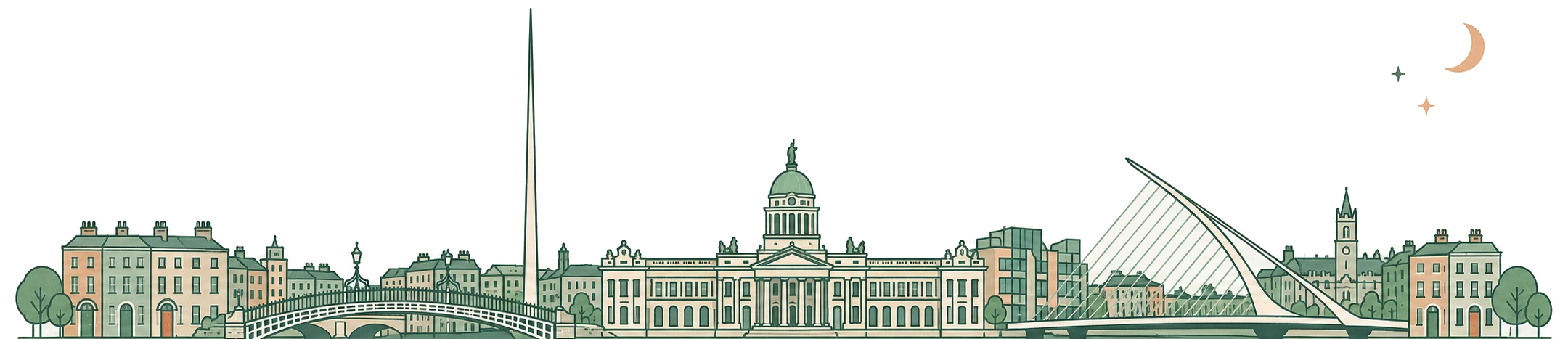
Dublin is a pub city first. Pubs serve until 11:30 p.m. Monday to Thursday and 12:30 a.m. on Friday and Saturday, so a late night depends on a special exemption order, which can run to 2:30 a.m. at the latest. A nightclub also needs a public dancing licence. Temple Bar holds the traditional pubs, Harcourt Street the late bars and clubs, and Camden Street and George’s Street the music rooms and bars. The year peaks at St Patrick’s Day on 17 March and the October bank holiday weekend around Halloween. County Dublin has 1.46 million people. Licensing reform is still pending, so an operator plans around the current hours: staff, door times and table turns all work back from the late exemption.

Dublin bar rules: closing time, licences and noise.

What the State and the courts ask of a licensed room, from the end of service to the door. Liquor licences come from the Revenue and the District Court.

The night, by the clock6 p.m. to 4 a.m.

Pubs open at 10:30 a.m. every day except Sunday, when sales start at 12:30 p.m. A special exemption order is granted by the District Court for an occasion, not as a standing right. Licensing reform has been proposed but has not passed.

Staff and the door

  • Door supervisors

    €150

    Anyone working as a door supervisor in a licensed premises needs a Private Security Authority licence.

    More

    A new application takes about six weeks to process, and the PSA checks criminal records and training documents. A combined door and guarding licence is €220.

    Source: PSA fees
  • Age and ID

    18+

    You must be 18 to buy alcohol. Selling or giving it to anyone under 18 risks a fine of up to €5,000 and a closure order for the licence holder.

    More

    The Garda Age Card costs €10 and proves age only; it is not an identity card. Citizens Information lists no accepted IDs, so set a door policy and keep to it.

    Source: Citizens Information
  • Service charges and tips

    Shared

    Under the Tips Act 2022, a charge called a service charge, or anything that leads a guest to think it pays for service, is shared with staff as if it were a tip.

    More

    Printing “service charge” on a bill means it belongs to the team, not the house.

    Source: Department of Enterprise, Tourism and Employment

The room

  • Publican’s licence

    Circuit Court

    A new ordinary publican’s on-licence application is lodged with the Circuit Court.

    More

    Occasional licences from the District Court are only for existing licence holders.

    Source: Citizens Information
  • Public dancing licence

    Licence

    A venue with live music or one run as a nightclub or disco needs a Public Music and Singing Licence and/or a Public Dancing Licence from the local District Court.

    More

    A pub licence alone does not cover a dance floor.

    Source: Citizens Information
  • Minimum price and happy hours

    €1 a drink

    Minimum unit pricing since 4 January 2022 is 10c per gram of alcohol, so a standard drink cannot sell for less than €1. Happy hours are illegal, as are price promotions shorter than 3 days.

    More

    Price a bottle table or a drinks package by the gram, and run any offer for at least 3 days.

    Source: Citizens Information
  • Children in the bar

    Under 15

    Children under 15 may only be in the bar between 10:30 a.m. and 9 p.m., or 10 p.m. from May to September, and supervised.

    More

    Keep under-15s out of a room that is open late.

    Source: Citizens Information

Hours and later nights

  • Pub hours

    12:30 a.m.

    On-sales run 10:30 a.m. to 11:30 p.m. Monday to Thursday, to 12:30 a.m. Friday and Saturday, and 12:30 p.m. to 11 p.m. Sunday.

    More

    Later hours come only through a special exemption order.

    Source: Citizens Information
  • Special exemption order

    2:30 a.m.

    A special exemption order lets a licence holder serve outside ordinary hours. The latest time alcohol can be served for drinking on the premises is 2:30 a.m. Apply to the local District Court.

    More

    Plan every late night around an order. The court fee and stamp duty are not confirmed here, so ask the Courts Service before you budget.

    Source: Citizens Information
  • Restaurant certificate

    1 hour

    A pub serving a substantial meal, one that costs more than €9, may serve alcohol with that meal for one hour after the normal hours.

    More

    It applies to the meal, not the room, so it does not make a late bar.

    Source: Citizens Information
  • Reform is pending

    Not passed

    The Sale of Alcohol Bill 2022 did not progress in the lifetime of the last Government, and the Department of Justice says key reforms will be folded into an Intoxicating Liquor Bill.

    More

    Proposals have included later bar hours and nightclub permits, but none is law. Plan on today’s hours.

    Source: The Irish Times

General information, not legal advice. Laws and licence conditions change and vary by venue. Confirm with the Courts Service, Revenue or the Private Security Authority before acting on it.

Prices, VAT and the bill in Dublin.

How a table’s bill adds up once tax and a service charge are on it, and what guests pay at the door.

A table on a SaturdayWorked example, not a quote
A table on a Saturday: how the bill adds up
Minimum spend€1,000.00
Service charge 10%, added by the venue€100.00
VAT 23%, included in the prices€205.69
Guest pays€1,100.00
Tip the guest chooses to addNo tax
  • Prices include VAT. Alcohol is charged at the standard rate, 23%, so bottles and mixers at a table carry 23%.

    Source: Revenue
  • Food and drink sold as part of a restaurant or catering service moved to 9% on 1 July 2026. Alcohol stayed at 23%.

    Source: Revenue
  • Revenue treats a service charge on a catering bill as part of the price of the meal, so it carries VAT; a tip a guest adds freely and that is not on the bill is outside VAT. A drinks-only bill has no entry of its own, so the example taxes the charge at the drinks rate. Check with Revenue.

    Source: Revenue
  • Entry to a nightclub is standard rated, and the licensee is treated as the promoter of the dance.

    Source: Revenue
  • The Tips Act 2022 treats a charge called a service charge like a tip, so it is shared with staff.

    Source: Department of Enterprise, Tourism and Employment

Club ticket prices and table minimums in Dublin

Rough estimates for tickets and bottle-service tables, from public listings and venues’ own pages.

Club night ticketsGeneral estimate

€10 to €25

Typically about €15

No Dublin venue publishes a club night price on its own page, so this is a general estimate for a Thursday to Saturday club night, generalised from comparable European cities. Headliner and holiday nights cost more.

Table minimumsGeneral estimate

€300 to €800

A typical table, about €500

No Dublin club publishes a table minimum on its own page, so this is a general estimate for the lowest table, generalised from comparable European cities, before the service charge. Prices include VAT.

Figures are estimates from the sources and samples listed. They change often and may be wrong. Check with the venue or the relevant authority before relying on them. Venues and events named here aren’t affiliated with VenueStack and haven’t endorsed this guide.

Bar staff wages, minimum wage and tips in Dublin.

The legal minimum wage, and the rules on tips and pay.

Minimum wageStatutory minimum for age 20 and over; wages by role are not published at city level

Minimum wage €14.15 an hour, since 1 January 2026Source: Irish Statute Book

Dublin’s biggest nightlife dates.

The nights that fill a room, or empty it, month by month.

  1. January

    • 1 JanNew Year’s Day

      A public holiday that follows New Year’s Eve, when late trade runs into it.

      Official site
  2. February

    • First Monday in FebruarySt Brigid’s Day

      A long weekend in the quiet start of the year. When 1 February falls on a Friday, the holiday is that Friday.

  3. March

    • 17 MarSt Patrick’s Day

      A public holiday and the city’s biggest festival weekend, with a parade and a five-day festival.

      Official site
  4. April

    • Late March or AprilEaster weekend

      Easter Monday is a public holiday, so the Sunday trades like a Saturday.

  5. May

    • First Monday in MayMay bank holiday

      A holiday Monday, so the Sunday before trades like a Saturday.

  6. June

    • First Monday in JuneJune bank holiday

      A holiday Monday, so the Sunday before trades like a Saturday.

  7. July

    No city-wide dates

  8. August

    • First Monday in AugustAugust bank holiday

      A holiday Monday, so the Sunday before trades like a Saturday.

  9. September

    • Usually mid SeptemberNocturnal Beats

      A night culture programme within the Dublin Fringe, from live music and club nights to cabaret and drag.

      Official site
  10. October

    • Last Monday in OctoberOctober bank holiday

      A holiday Monday, so the Sunday before trades like a Saturday.

    • 31 OctHalloween

      When it falls near the October bank holiday weekend, the parties run across the long weekend.

  11. November

    No city-wide dates

  12. December

    • 25 and 26 DecChristmas Day and St Stephen’s Day

      Public holidays, so holiday pay applies to staff.

    • 31 DecNew Year’s Eve

      The biggest late night: a special exemption order allows service to 2:30 a.m. at the latest.

      Official site

Dublin nightlife districts.

Dublin’s nightlife districts and the rooms each is known for.

District points © OpenStreetMap contributors
  1. Temple Bar

    Cobbled streets of traditional pubs and live Irish music, the most tourist-heavy and expensive area.

  2. Harcourt Street

    A strip of late bars and nightclubs.

  3. Camden Street and Wexford Street

    A local and music fans’ area of bars and live venues; the Council’s Dublin Nights Help Zone van operates on Camden Street.

  4. George’s Street

    The “bohemian quarter”, with bars and a late-night crowd.

Dublin nightlife by the numbers.

Who lives and works in the area. These describe County Dublin’s population, not any venue’s guests.

County population
1.46MCensus 2022, up 8% since 2016Source: Central Statistics Office
At work in Dublin City
300,200+Census 2022Source: Central Statistics Office

Dublin nights,on VenueStack.

Sell tickets, take table bookings with deposits, run the guest list and check guests in at the door, in one place. Built for clubs, lounges and bars.

Dublin bar andnightclub questions.

Pubs serve until 11:30 p.m. Monday to Thursday, 12:30 a.m. on Friday and Saturday, and 11 p.m. on Sunday, when sales start at 12:30 p.m. Later service needs a special exemption order, and the latest time alcohol can be served for drinking on the premises is 2:30 a.m.

Temple Bar holds the traditional pubs, Harcourt Street the late bars and clubs, Camden Street and Wexford Street the music fans’ bars and live venues, and George’s Street the bohemian quarter. Hours are the same in every area, so the difference is the crowd and the competition.

The latest a special exemption order allows service of alcohol for drinking on the premises is 2:30 a.m. A venue with live music or a dance floor also needs a Public Music and Singing Licence and/or a Public Dancing Licence from the local District Court.

It lets a licence holder serve alcohol outside ordinary opening hours, to 2:30 a.m. at the latest. Apply to the local District Court. The court fee is not confirmed on this page, so ask the Courts Service.

Reform is pending. The Sale of Alcohol Bill 2022 did not progress in the lifetime of the last Government, and the Department of Justice says key reforms will be folded into an Intoxicating Liquor Bill. Until something passes, the current hours apply.

Yes. A venue with live music or one operating as a nightclub or disco needs a Public Music and Singing Licence and/or a Public Dancing Licence from the local District Court, on top of a publican’s licence. A new ordinary publican’s on-licence application goes to the Circuit Court.

Yes. Anyone working as a door supervisor in a licensed premises needs a Private Security Authority licence. It costs €150 and a new application takes about six weeks to process.

18. Selling or giving alcohol to anyone under 18 risks a fine of up to €5,000 and a closure order for the licence holder. The Garda Age Card, €10, proves age but is not an identity card.

No. Happy hours are illegal, as are price promotions shorter than 3 days. Minimum unit pricing since 4 January 2022 is 10c per gram of alcohol, so a standard drink cannot sell for less than €1.

Alcohol is 23%. Food and drink sold as part of a restaurant or catering service moved to 9% on 1 July 2026, but alcohol stayed at 23%. Entry to a nightclub is standard rated. Prices include VAT.

The staff. Under the Tips Act 2022, a charge called a service charge, or anything that leads a guest to think it pays for service, is shared with staff as if it were a tip. Revenue treats a service charge on a catering bill as part of the price of the meal, so it carries VAT.

€14.15 an hour for age 20 and over from 1 January 2026. The age rates are €9.91 under 18, €11.32 at 18 and €12.74 at 19.

No Dublin venue’s own page gives a price we could read, so this is a general estimate from comparable European cities: roughly €10 to €25 for a club night and €300 to €800 for the lowest table, before the service charge. Prices include VAT.

Sources

VenueStack publishes this guide for general information. We take care to keep it accurate and list our sources and review dates, but we can’t guarantee it is complete, current or correct, and we aren’t responsible for decisions made on it. Nothing here is legal, tax or financial advice. Prices, minimums and wages are estimates from the samples described and don’t represent any particular venue. Venues, events and organisations named here aren’t affiliated with VenueStack and haven’t endorsed this guide.

Data gathered in October 2026. Spotted something out of date? Tell us.

All 16 sources
  1. Alcohol and the lawCitizens Information
  2. Age CardCitizens Information
  3. Public holidaysCitizens Information
  4. Licence fees (employees)Private Security Authority
  5. “We’re only half doing nightlife in Ireland”: campaigners call for reformsThe Irish Times
  6. Alcoholic drinks: VAT ratesRevenue
  7. Restaurant, catering and canteen servicesRevenue
  8. What is the VAT treatment of dances?Revenue
  9. Service charge (catering): VAT ratesRevenue
  10. Payment of Wages (Amendment) (Tips and Gratuities) Act 2022Department of Enterprise, Tourism and Employment
  11. S.I. No. 472/2025: National Minimum Wage Order 2025Irish Statute Book
  12. Census of Population 2022: summary results, DublinCentral Statistics Office
  13. What’s next: Dublin NightsDublin City Council
  14. Dublin NightsDublin City Council
  15. Dublin nightlifeIreland Before You Die
  16. Insider’s guide to Dublin nightlifeLast Night of Freedom

More city guides.

View all city guides