For venue operators, the booking widget vs third party marketplace decision starts with a question: what does each fee buy? Some charges pay for booking software. Others cover payment processing or access to an audience. Those costs deserve separate scrutiny.
A booking widget puts reservations or ticket checkout on your website. A marketplace lets guests discover and book venues or events through its own destination. This guide compares four booking models by cost, guest records, payout timing, and operating fit. Supplier-specific rates and contract terms need a dated quote.
Separate booking infrastructure from guest acquisition
Choose a booking channel according to the work you need it to do. A nightclub with returning guests has a different acquisition problem from a festival launching its first event.
An event ticketing platform can provide both website checkout and marketplace distribution. The interface alone tells you little about the commercial agreement. An embedded widget can carry percentage charges, while a marketplace agreement can include several payment structures.
Compare proposals across four areas:
- Calculate software, transaction, processing, and distribution charges at the same booking volume.
- Check which guest fields you can access, export, and use for permitted follow-up.
- Establish when funds become available, including any holds or deductions.
- Demonstrate how tickets, tables, deposits, and admissions work during the same event.
The shortlist below groups buying models by those jobs. It avoids named marketplace rankings because current provider pricing, data permissions, and settlement terms are unavailable here. Treat the recommendations as a way to narrow your options before requesting comparable proposals.
Four booking models worth putting on your shortlist
These models earn a place for different reasons: existing demand, new audience access, reservation complexity, or a mix of sales channels.
Direct ticket widgets for an audience you already reach
Start here when your website, mailing list, promoters, and returning guests already generate demand. The main advantage is a booking route attached to the venue’s own online presence.
Inspect the full cost structure. Ask suppliers to separate the subscription, any per-ticket charge, payment processing, and optional services. Website placement does not establish whether the platform takes a percentage of sales.
The limitation is acquisition. Installing checkout gives interested guests somewhere to buy; it creates no automatic audience. Include advertising and promoter costs when evaluating the channel.
For implementation context, website booking widgets are relevant to venues keeping their existing site. During a demonstration, complete a mobile purchase, open the confirmation, and retrieve the booking at check-in.
Prioritize this model when you can supply traffic and the documented total cost works at both ordinary and busy-night volumes.
Marketplace-led sales for events that need discovery
Consider this route when reaching unfamiliar guests is a purchasing objective. Its potential value is distribution: someone may encounter your event while comparing things to do.
Ask what triggers each charge. Does a commission apply to every booking, only marketplace-originated purchases, or a separately promoted allocation? Check whether paid placement costs extra and whether processing sits outside the quoted fee.
The limitation is attribution. A booking credited to the marketplace may come from a guest who already intended to attend. Reported sales alone cannot establish additional demand.
Request a sample settlement, current payout terms, and an explanation of source reporting. Compare marketplace bookings with your own campaign links and returning-guest records where possible.
Keep this model on the shortlist when you can test audience acquisition with a defined allocation. Expand it after the results show enough additional contribution to cover its additional cost.
Reservation-focused widgets for tables, cabanas, and deposits
This route fits venues where the booking represents a physical resource: a table, daybed, cabana, or timed seating. The useful distinction is how the system handles availability, party size, deposits, and changes.
Compare any subscription, per-reservation, processing, and deposit-related charges. Establish whether a deposit is collected immediately, held through another mechanism, or recorded without payment.
The limitation appears when reservation handling and event admission need different systems. A table confirmation may still leave staff with separate guest names, ticket entitlements, or balances to reconcile.
Ask the supplier to demonstrate a party-size change, a cancellation, and a booking moved between resources. For a beach club, test a daybed reservation against the actual operating schedule.
Choose this model when resource allocation drives the night’s workflow. Require a demonstration of how each reservation becomes a usable arrival record for staff.
Combined direct and marketplace sales for mixed demand
A combined approach fits venues with an established audience and specific events that need wider exposure. Direct booking handles existing demand; a marketplace allocation tests additional reach.
Its cost signal is the combined bill. Include both systems, channel charges, integrations, and staff time spent reconciling records. A small commission saving can disappear into manual work.
The limitation is coordination. Two sales channels need reliable availability updates, clear refund responsibilities, and a workable admissions process.
Ask whether the channels share live inventory or depend on separate allocations. Request a demonstration of a cancellation returning stock, a table change, and an arriving party with bookings from both channels.
Use this approach when each channel has a defined purpose and the operating connection is proven. Set an allocation, an owner, and a reconciliation process before opening both channels for sale.
Follow the money from checkout to payout
A booking channel’s price becomes clearer when you separate the charges and trace the resulting cash movement.
Identify who receives each charge
A subscription pays for access to software under the agreed plan. A transaction charge follows a booking or ticket. Payment processing covers the payment service. Distribution or referral charges pay for access to another channel’s audience.
Ask suppliers to identify every deduction on a sample transaction. Include refunds, disputes, optional promotion, and any required add-ons in the discussion.
Then establish who pays. Passing charges to guests changes their checkout total; absorbing them reduces the venue’s proceeds. The practical trade-offs in passing ticket fees deserve a separate decision from choosing the booking channel.
Compare an identical guest-facing total across proposals. Otherwise, a cheaper-looking system may simply shift more of the bill to the buyer.
Test acquisition value with hypothetical numbers
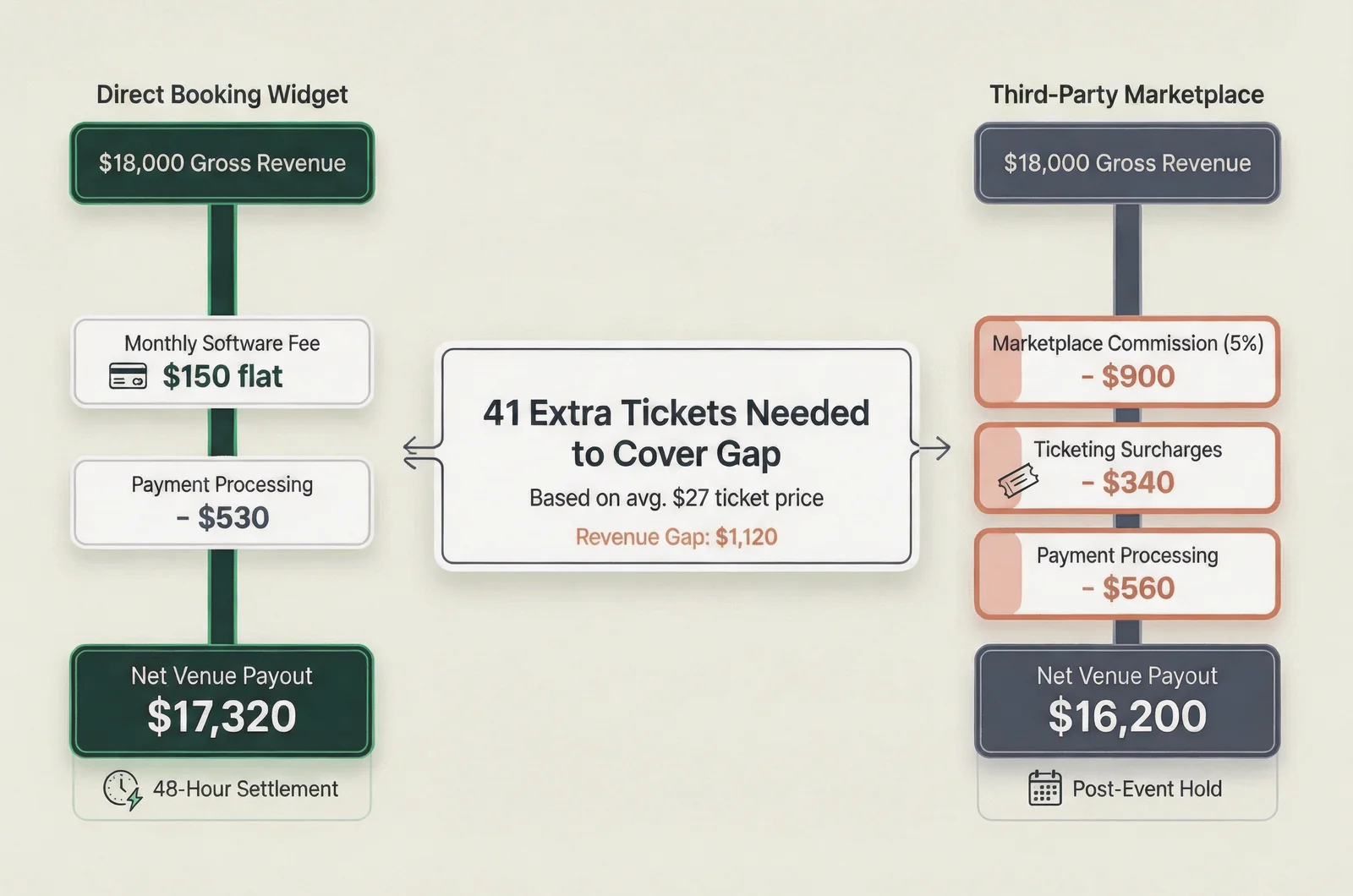
Suppose an event sells 600 tickets at $30, producing $18,000 in ticket revenue.
For illustration only, assume the direct software cost allocated to that event is $150. A marketplace alternative charges 5% of ticket revenue, or $900. Keep payment processing identical in this example.
The marketplace costs $750 more on those 600 bookings.
Now assume each genuinely additional guest contributes $20 after other variable costs, before the marketplace charge. Its 5% fee on a $30 ticket is $1.50, leaving $18.50 in additional contribution.
Covering the $750 difference requires 41 additional guests under those assumptions.
These figures are hypothetical, not quoted market rates. Substitute your own costs, ticket values, and margins. Count guests who would otherwise have stayed away, rather than every booking assigned to a channel.
Check the date cash becomes usable
Revenue booked and money available are different measures.
Request the payout trigger, expected bank-arrival window, deductions, and circumstances that can delay funds. Ask how cancellations, refunds, disputes, or reserves affect settlement.
Compare those terms with your supplier and staffing deadlines. A channel can produce acceptable margins while releasing cash too late for your payment schedule.
An interactive break-even calculator would help here: enter booking volume, ticket price, allocated software cost, channel fees, and contribution per extra guest. Its output should show the additional bookings needed to cover the cost difference.
Check who can use the guest record
Guest data belongs in the channel decision because repeat business depends on what your team can retain and use.
Ask for a sample export before signing. Check whether it includes booking references, contact details, attendance status, purchase history, and the relevant marketing permission fields. Establish which records remain accessible after the agreement ends.
Separate three questions: what you can see, what you can export, and what the agreement permits you to do with it. A dashboard login answers only the first.
For direct bookings, also inspect measurement across the full journey. A visitor clicking “book” and a guest completing payment are different events. The setup for analytics and pixels should reflect that distinction.
Marketplace attribution deserves the same scrutiny. Ask how the supplier assigns a booking source and whether you can reconcile that assignment with your own records.
Request an export containing a canceled reservation, an attended booking, and a repeat guest. Check those records against the information staff can see during service.
Make the booking survive a busy door
A low-cost booking channel still needs to produce records your team can use during the event. Compare its operating value with a realistic demonstration.
Use a scenario that reflects your venue: general admission tickets, a table deposit, a promoter allocation, and a guest whose party size changes.
Have the supplier show what happens when:
- A guest buys admission and later joins a table booking.
- Two staff members open the same reservation.
- A cancellation releases a resource for resale.
- A ticket is presented twice.
- The reporting team reconciles sales, refunds, deposits, and attendance.
For a nightclub, focus on table entitlements and admission together. For a festival, inspect ticket allocations and scanning. A beach club should test resource availability and reservation changes.
Ask who resolves a mismatch between channels and which record staff should trust. Establish the support route available during your operating hours.
Record the manual steps required to complete the demonstration. Price those tasks using your own staffing costs, then add them to the channel comparison.
Score each proposal against the same event
A consistent score helps compare booking proposals without mistaking an attractive headline fee for a complete agreement.
Use four criteria: total cost clarity, guest record access, usable payout timing, and demonstrated operating fit. Give each criterion:
- 0 when the supplier provides no usable answer.
- 1 when the answer is partial or an unresolved workaround remains.
- 2 when the requirement is documented and demonstrated where applicable.
The maximum is eight points. This is a purchasing worksheet, not an independent provider rating.
Keep a separate list of requirements that must pass. A high total cannot resolve payout terms that miss your funding deadline or inventory handling that allows double-bookings.
Request the same event scenario from every supplier. Include an ordinary night and a busy night, since percentage charges and fixed costs behave differently as volume changes.
If VenueStack reaches your shortlist, compare its platform pricing with its platform overview. Apply the same written-term and workflow checks used for every other candidate.
Favor direct booking when you supply demand and its economics and operations pass. Retain marketplace distribution where measured additional contribution supports the cost. Use both when the inventory connection and reconciliation process pass the demonstration.
Questions to settle before signing a booking agreement
The remaining booking-channel questions usually concern guest charges, access to cash, and the ability to move suppliers.
Can guests pay all the booking fees?
That depends on the supplier’s configuration and agreement. Ask for the final checkout total and a settlement showing the venue’s proceeds.
Also inspect a refund example. Confirm which charges return to the guest and which costs remain with the venue. Use that outcome in your event budget.
Will marketplace ticket sales help fund the event?
Only if the payout terms make funds available before your payment deadlines. Ask for a worked timeline from purchase through settlement to bank receipt.
Use the applicable terms for your account and event. Place those dates beside the deposit, staffing, and supplier payments you must make.
Can you take your guest list when you leave?
Confirm export access, included fields, permitted uses, and the deadline for retrieving records after termination. Request the answer in writing.
Before committing, open a sample export in the format your team would actually use. Check that booking identifiers and permission fields remain attached to the relevant guest records.