Run your cover charge vs presale tickets revenue comparison on what your venue keeps, when the money becomes available, and how many guests arrive. A higher door price can produce less income if fewer people buy. Advance sales can secure admission money while leaving gaps on the floor. Use the worksheet below to compare door-only, presale-led, and blended sales for one night.
Set up one night with a fixed capacity
Give all three admission models the same capacity and event costs. Otherwise, a model can appear stronger simply because you allowed it more guests.
Gather recent sales, check-ins, refunds, payment charges, and payout records from comparable nights. Separate ordinary weekends from special bookings. If reliable records are missing, label your attendance estimates as assumptions.
For this hypothetical exercise, use:
- 300 available guest places after accounting for everyone else who counts toward the event’s occupancy limit.
- 30 places reserved for table parties and complimentary admissions.
- 270 places available for paid general admission.
- A $25 cover for the door-only model.
- A $20 advance ticket and $25 door price for the presale-led model.
- A $22 advance ticket and $28 door price for the blended model.
Assume no turnover or resale of unused ticket places. Everyone with a valid admission entitlement retains a place.
Keep table revenue, bar sales, and separately collected taxes outside the initial calculation. Count table guests within capacity even when their booking includes admission. Add their admission revenue only if it is separately charged.
Your completed worksheet should answer three questions: which model produces the most net admission proceeds, whether its attendance assumptions are credible, and whether cash arrives before bills fall due. Start with the same 270 paid places in every column.
Calculate what each admission model leaves you
Compare gross receipts and net admission proceeds separately. The second figure is the money left after the direct charges included in your model.
Put every payment cost in the right column
For this example, assume one ticket per order, a $2 venue-paid charge per advance ticket, and a $1 charge per door payment. These are worksheet assumptions, not published provider rates.
Use:
Net admission proceeds = ticket and cover receipts − refunds − venue-paid payment and ticketing charges
Subtract chargeback losses and other direct admission costs when they apply. Keep fixed event expenses separate until you calculate event contribution.
For VenueStack, take applicable software costs from its ticketing software pricing, then add the payment charges that apply to your account. Allocate a monthly subscription consistently across all three models.
If guests pay a separate fee, keep that amount outside your ticket revenue unless you retain it. Compare the full checkout price when assessing demand.
Run three explicit sales forecasts
Assume 90% of advance ticket holders attend. All door purchasers enter.
| Model | Sales assumed | Paid arrivals | Gross admission | Venue-paid charges | Net proceeds |
|---|---|---|---|---|---|
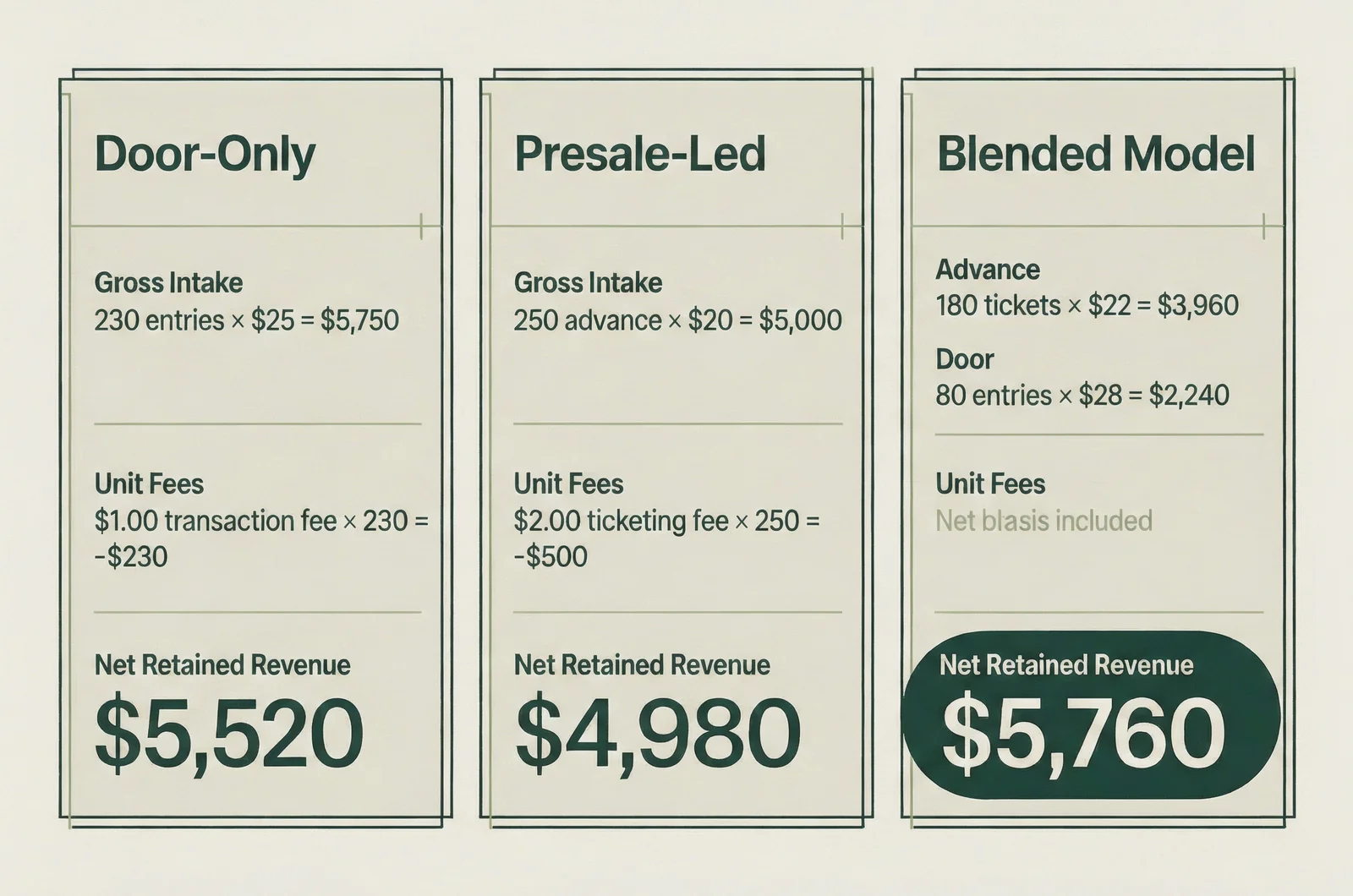
| Door-only | 230 covers at $25 | 230 | $5,750 | $230 | $5,520 |
| Presale-led | 250 advance at $20; 20 covers at $25 | 245 | $5,500 | $520 | $4,980 |
| Blended | 180 advance at $22; 80 covers at $28 | 242 | $6,200 | $440 | $5,760 |
The blended setup reserves 90 places for walk-ups but assumes only 80 sell. The presale-led setup allocates its remaining 20 places to door sales.
Under these assumptions, the blend produces $240 more than door-only and $780 more than presale-led. Those differences are forecasts. Replace each sales count with evidence from comparable nights before committing inventory.
Find the walk-up sales your blend needs
Calculate the door-sales threshold before choosing the blend. This tells the manager how much walk-up demand the plan requires.
The blended model retains $20 from each $22 advance ticket after the assumed $2 charge. Its 180 advance sales therefore produce $3,600.
Each $28 door sale contributes $27 after the assumed $1 charge. To match the door-only forecast:
Required door sales = ($5,520 − $3,600) ÷ $27
Round up to 72 covers. At 71 covers, the blend produces $5,517. At 72, it produces $5,544.
That threshold fits within the 90-place walk-up allocation. Now test demand: do comparable nights support at least 72 walk-up purchases at $28? A forecast based on $25 covers cannot establish that by itself.
Repeat the calculation for a quiet night, expected night, and strong night. Change ticket volumes and attendance assumptions explicitly. Avoid raising the price while assuming demand stays unchanged.
A useful interactive worksheet would accept capacity, ticket allocations, prices, charges, and expected attendance. It could return net proceeds, the walk-up break-even count, and a warning when admission commitments exceed available places.
Save all three demand scenarios beside the pricing plan.
Separate retained ticket money from attendance
Model no-shows twice: once for admission proceeds and once for spending inside the venue. The results affect different parts of the night’s economics.
Keep paid no-shows in the correct calculation
In the example, assume advance sales remain paid and no refunds occur. A guest’s absence therefore leaves admission proceeds unchanged.
The presale-led model sells 250 advance tickets but expects 225 advance arrivals. The blend sells 180 and expects 162.
Do not multiply retained ticket receipts by the attendance rate. That would incorrectly remove money from paid tickets. Apply attendance to the guest count, then use the refund assumptions to adjust receipts.
In VenueStack, use distinct event ticket types to keep advance tiers identifiable. Compare each tier’s sales with its check-ins rather than treating all advance buyers as one group.
Add spending contribution and refund exposure
For another hypothetical input, assume each arriving paid guest contributes $12 after the direct costs of their bar purchases. Use contribution rather than gross bar sales.
The blend expects 12 more paid arrivals than door-only. That adds $144 in bar contribution to its $240 admission advantage, for a combined $384 difference before other cost changes.
Refunds need a separate stress test. Ten $22 refunds reduce the blend’s admission proceeds by $220 if the illustrative charges remain payable. Its $5,760 falls to $5,540, just $20 above the door-only forecast.
Enter the actual refund terms and charge treatment before relying on that remaining margin.
Check when ticket sales become spendable cash
Place the sales forecast beside a dated cash schedule. Selling tickets before the event does not establish when those funds reach your bank.
Record the first usable payout date, any withheld amount, and charges deducted from each payment method. Use your account’s actual payout terms. Keep gross ticket sales, available platform balance, and bank receipts in separate worksheet columns.
For a hypothetical schedule, suppose a $1,200 supplier balance is due Thursday, but advance-sale funds become available Monday after the event. Those sales contribute $0 toward Thursday’s payment.
Calculate:
Pre-event funding gap = bills due before opening − unrestricted cash available by those dates
Check the dates against supplier deposits, staffing payments, marketing commitments, and any other pre-event obligations.
Treat door receipts with the same care. Record when card payments become usable, and reconcile cash collected against the amount deposited.
Then add a refund reserve appropriate to your event’s terms and exposure. Money earmarked for likely refunds should remain outside the amount available for other bills.
The expected result is a calendar of cash movements. Verify that every payment due before opening has a named funding source.
Protect paid places through the door rush
Translate the sales mix into admission rules before tickets go live. A profitable spreadsheet fails operationally if advance holders arrive after staff have sold their places.
Keep unused entitlements reserved
At opening, the blended plan has 180 advance commitments and 90 places allocated to walk-ups. Low early attendance does not automatically increase that walk-up allocation.
Track current occupancy separately from unredeemed admissions. A scan count alone cannot show how many valid ticket holders may still arrive.
Do not release a paid guest’s place simply because their expected arrival time has passed. Any arrival deadline or release rule needs clear terms and an operating process established before purchase.
Use the pre-sale ticket checks to review allocations before opening sales. Confirm that tables, complimentary entries, and paid tickets draw from the same total guest allowance.
Give door staff one admission record
Document who can change the cover price, issue complimentary admission, approve a refund, or release inventory. Record each change with its time and reason.
Run a sample advance admission and a sample walk-up purchase through the ticket check-in workflow. Confirm that each produces one admission record and the correct payment status.
Keep payment exceptions out of the main scanning queue where staffing permits. Give one manager responsibility for resolving duplicates and disputed admissions.
Before opening, verify that staff can distinguish a paid ticket, a complimentary place, and a table guest whose admission is already included.
Reconcile the night before changing the mix
Compare the forecast with actual sales and attendance after the event. A stronger next plan needs a clear explanation for each difference.
Match sales, admissions, and cash
Reconcile advance tickets sold, refunds, chargebacks, ticket check-ins, door transactions, complimentary admissions, and table guests. Match payment totals to settlements and bank deposits.
VenueStack’s sales and attendance reporting can support this review. Use the morning-after reconciliation as a separate check on the event forecast.
Keep a per-night worksheet with planned and actual columns. Preserve the original plan so later edits cannot erase the variance.
Investigate duplicate scans and unmatched payments before using the figures to set another ticket allocation.
Explain why the result moved
Suppose the blend sells only 60 door admissions. Its net proceeds become:
$3,600 + (60 × $27) = $5,220
That is $300 below the door-only forecast. It is not proof that door-only would have earned more that night, because its 230-cover assumption remains untested.
Check whether the shortfall came from fewer arrivals, resistance to the $28 price, admission delays, or unavailable inventory. Use timestamped sales and entry records where possible.
Change one main pricing variable for the next comparable event. Keep the other assumptions visible, including artist, promotion, opening hours, and capacity. Save the actual walk-up count alongside the 72-cover threshold.
Resolve the pricing questions before tickets go live
Set answers to guest-facing pricing questions while the admission mix is still editable.
How many places should stay available at the door?
Work backward from credible walk-up demand and the advance commitments you can support. In this exercise, the blend reserves 90 places and needs 72 door purchases to beat the door-only forecast.
If records suggest only 50 likely walk-ups, rerun the model before preserving all 90 places. Check that additional advance demand exists before shifting inventory.
Should advance tickets always cost less?
Test the difference against the behavior you want. A lower advance price gives up revenue per buyer in exchange for an earlier purchase.
In the example, the presale-led model brings in more paid guests than door-only but retains $540 less in admission proceeds. Check whether any extra spending contribution or earlier usable cash covers that gap.
Can fees passed to guests change the result?
Rerun both the venue’s proceeds and the guest’s checkout price. Moving charges to buyers changes who pays them, but the higher checkout total may change purchases.
Keep the displayed ticket price, total guest payment, and amount retained in separate columns. Use the resulting sales and attendance records to set the next allocation.