Choosing a partial vs full deposit for table bookings affects both checkout and attendance. For nightclub, lounge, and beach club operators, a larger upfront payment puts more money behind a reservation. It may also make the group organizer hesitate before paying.
The useful comparison follows the whole booking: payment, cancellation, arrival, remaining spend, and possible resale. A lower no-show rate can still leave you with fewer occupied tables if too many guests abandon checkout. Start by defining what guests are paying for, then compare the results across similar events.
Define what the deposit actually covers
A partial deposit collects part of an agreed booking amount upfront. Full prepayment collects the entire agreed amount. Neither label explains whether that payment covers a table fee, a package, or credit toward a minimum spend.
Those distinctions matter at the door.
Consider a hypothetical table with an $800 minimum spend. A $200 partial deposit credited toward that minimum leaves $600 to spend or settle. Collecting the full $800 upfront covers the stated minimum, but the guest might still owe taxes, service charges, or purchases beyond it, depending on the terms.
A separate reservation fee works differently. If the guest pays $200 to reserve the table and that payment does not count toward the minimum, the total commitment is higher. Make that difference visible before payment.
Refundability is another separate choice. Both partial and full payments can have cancellation terms. The amount collected and the conditions for returning it need their own explanations.
Use the same definitions in checkout, confirmations, and table deposit requests. Staff should be able to answer three questions from the booking record: how much was paid, what it covers, and what remains due.
Why a larger payment can change who books
The deposit amount changes the commitment guests make before the event. Its effect on attendance depends partly on the guests who complete that commitment.
Money at stake can encourage a decision
A paid reservation gives the organizer a financial reason to keep the booking or contact the venue about a change. Full prepayment puts a larger amount at stake.
That does not make attendance certain. Travel problems, illness, and changes within the group can still prevent arrival. A clear cancellation route gives those guests a way to release the table.
The timing of that release matters. An early cancellation may leave enough time to sell the table again. A silent absence discovered after the arrival deadline leaves a shorter window.
Measure how much notice each policy produces, alongside the number of guests who arrive.
Checkout asks one person to commit the money
For group bookings, the person paying may still be collecting contributions from friends. A larger payment can increase that person's immediate burden, even when everyone accepts the total price.
A partial deposit may let the organizer confirm sooner. Full prepayment may appeal when the package and headcount are already settled.
Treat these as possibilities to test. Separate payment failures, abandoned checkouts, completed bookings, and later cancellations in your records. Otherwise, a stricter payment policy can appear successful because you only count the smaller group that finished paying.
Match the amount to the table's resale window
The right deposit depends on how much usable selling time disappears when a guest fails to arrive. Venue type provides context, but demand for that specific event should guide the decision.
Nightclub tables with concentrated demand
A premium booth on a busy event night may have a short arrival window and several potential buyers. Full prepayment is worth testing when guests understand the package and demand supports the upfront commitment.
Still, payment does not decide how long to hold an empty booth. Set an arrival deadline, a contact process, and a release rule. A fully paid booking can block available inventory if nobody knows when staff may release it.
Lounge bookings with uncertain group plans
A lounge reservation may involve a group whose final size remains unsettled. A partial deposit can create a financial commitment while leaving part of the payment until later.
The operational weakness is the outstanding balance. Decide when it becomes due and who handles collection. If a table is held through the busiest seating period, evaluate the deposit against that lost selling opportunity.
Beach club daybeds and cabanas
Outdoor bookings need clear explanations of what happens when conditions change. Guests need to distinguish a venue closure from their own decision to cancel.
Full prepayment creates a larger amount to resolve if a booking changes. A partial deposit leaves more money to collect when the visit proceeds.
Record the applicable policy in event table booking rules. Keep the payment requirement consistent with the weather, arrival, and cancellation terms shown for that event.
Show the guest the complete payment agreement
Both deposit structures need a clear agreement before payment. Confusion about the remaining balance can turn a confirmed booking into an argument at check-in.
The guest should be able to find:
- The amount charged today and the total booking commitment.
- Whether the payment counts toward the minimum spend.
- Any excluded charges and when the balance becomes due.
- The arrival deadline and how long the table will be held.
- The cancellation deadline and the stated refund treatment.
- What happens if the group size, event, or venue availability changes.
For the hypothetical $800 table, describing the payment as a $200 deposit leaves several questions open. State that $200 counts toward the $800 minimum, explain the remaining $600 commitment, and identify any excluded charges.
A later balance deadline creates another decision. If payment is incomplete at that deadline, does the reservation remain confirmed, enter review, or become eligible for release? Staff need a defined response.
Keep the terms accepted at purchase attached to that booking. Updating the policy for a future event should not leave staff guessing which version an earlier guest saw.
Send the payment breakdown again in the confirmation and arrival reminder. The person who paid may need to share it with the rest of the group.
Separate collected money from the loss you are protecting
Full prepayment collects more of the agreed booking amount before arrival. It does not tell you how much value an empty table costs.
An absent group may leave unused stock, while staffing and reserved space still carry costs. You may also lose purchases beyond the minimum. If another group takes the table, some of that opportunity may be recovered.
Assess the result using the final outcome: payments retained, refunds, replacement sales, service costs, and any disputed amounts. Avoid counting a deposit twice when it later becomes credit against the guest's bill.
The partial deposit creates a smaller initial payment. Whether it protects enough depends on what happens after cancellation and how quickly staff can resell the table.
Full prepayment also means a larger payment needs to be resolved when a guest challenges the charge. Keep the booking description, accepted terms, confirmation, guest messages, and arrival or cancellation record together. Clear records give staff a consistent account of what happened.
Your table deposit refund workflow should identify who can approve a refund and where the decision is recorded. Resolve the booking status and the payment status separately: a released table can still have an unresolved payment.
Carry one booking record from checkout to the floor
Either deposit structure becomes harder to manage when reservations, payments, and arrivals live in separate systems. A door team needs the guest's current position without reconstructing it from messages.
VenueStack's unified venue management platform brings table bookings, deposits, check-in, and reporting into one system. The practical aim is to let reservations, door, and floor staff work from the same booking information.
For the hypothetical partial-payment booking, staff need to see the $200 collected and the remaining $600 commitment. With full prepayment, they need to see what the $800 covers and which additional charges may remain.
Payment status and attendance status should stay distinct. A booking can be fully paid while its guests have not arrived. A checked-in group can still have a balance to settle.
Exceptions need an owner. Decide who handles late arrivals, reduced groups, payment adjustments, and table releases. Record the decision where the next staff member can find it.
At the end of the event, reconcile the booking against the final bill. Include deposit credit, additional payments, refunds, and unresolved items. That closes the gap between the amount reservations collected and the amount the venue ultimately received.
Measure attended tables alongside checkout conversion
A deposit policy needs two views: what happens before confirmation and what happens after it. Tracking attendance alone leaves checkout losses invisible.
Keep the denominators consistent
Checkout conversion measures completed bookings against checkout starts. The no-show rate measures bookings that fail to arrive against the confirmed bookings expected that session, with cancellations recorded separately.
Choose a consistent rule for late arrivals and partially attended groups. Keep timely cancellations and late cancellations separate so you can see how much resale time each leaves.
VenueStack's table reservation reporting can support the review of table results. Compare those records with checkout activity, refunds, and final payment outcomes where available.
Use a few operational measures together:
- Completed bookings per 100 checkout starts.
- Attended tables per 100 checkout starts.
- Timely cancellations, late cancellations, and no-shows.
- Released tables that were sold again.
- Final receipts and contribution after relevant costs.
Keep the event type, table package, booking lead time, and arrival rules as comparable as possible.
A lower no-show rate can accompany fewer arrivals
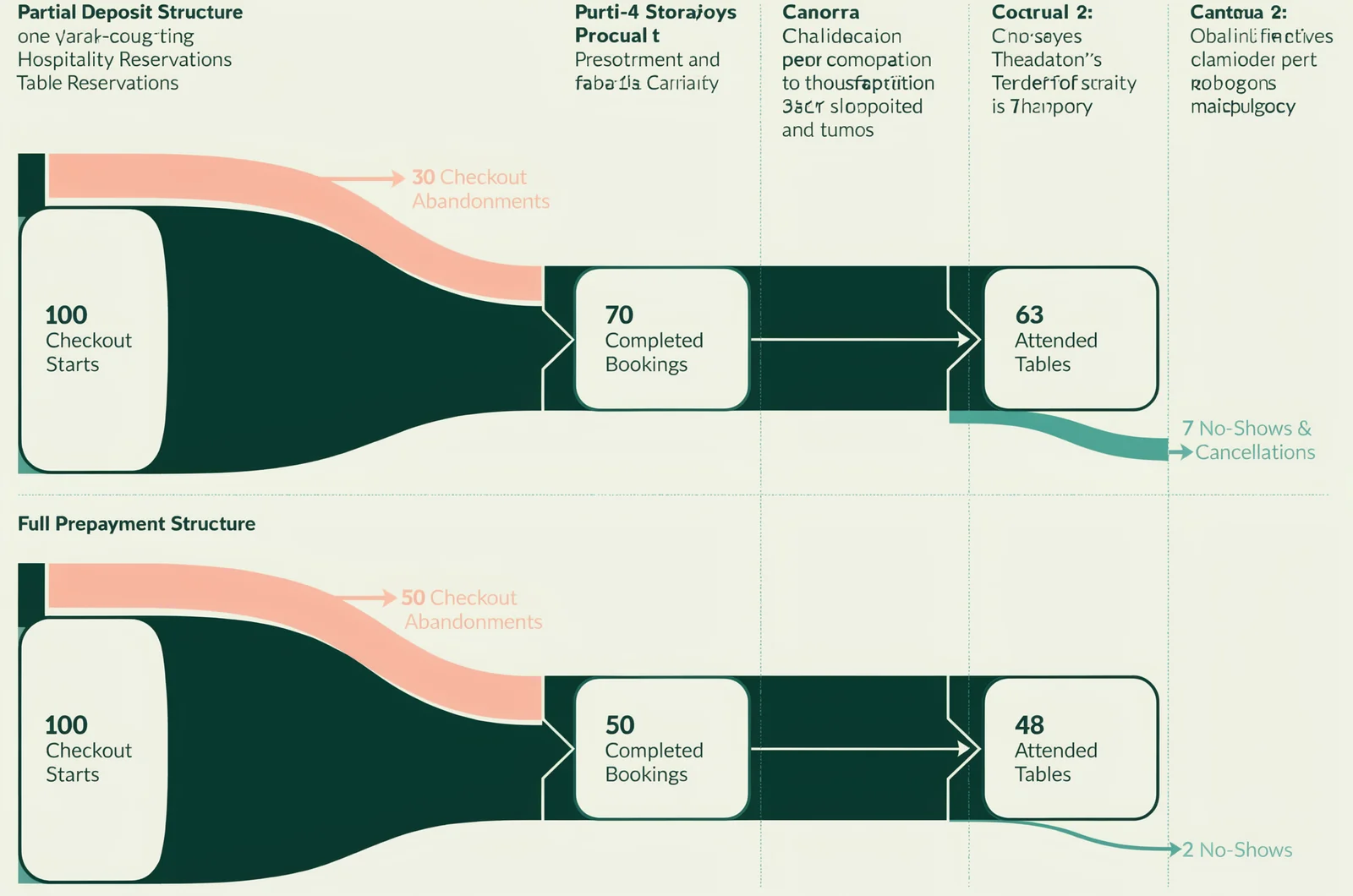
Consider illustrative results from 100 checkout starts under each policy.
With a partial deposit, suppose 70 guests complete a table booking. Seven bookings fail to arrive, so the no-show rate is 10% and 63 tables attend.
With full prepayment, suppose 50 guests complete a booking. Two fail to arrive, so the no-show rate is 4% and 48 tables attend.
The full-payment policy has the lower no-show rate in this example. The partial-payment policy produces 15 more attended tables from the same number of checkout starts.
Neither result establishes which policy earns more. That calculation also needs actual spending, retained cancellation payments, refunds, resale, and service costs.
A useful deposit estimator would accept checkout conversion, attendance, average spend, refunds, resale, and costs, then compare attended tables and estimated contribution.
Set a review period across comparable events. Change one payment condition at a time, and record the policy used on each booking.
Payment questions that need an answer before launch
Some deposit decisions concern timing and exceptions rather than the percentage collected. Set these rules before staff begin taking reservations.
Should the remaining balance be due before arrival?
Collecting the balance before the event reduces the amount staff must collect on arrival. It also adds another payment deadline for the guest.
If you use that approach, specify the due date, reminder process, and consequence of missing payment. Review how many partially paid reservations actually reach full payment before you judge the initial deposit's conversion rate.
What happens when only part of the group arrives?
Separate attendance from the booking commitment. A smaller group may still occupy the reserved table, while a per-person package may need a different adjustment.
Show the agreed headcount and payment basis in the booking. Give staff a clear approval route for changes, then record any adjustment to the minimum, package, or balance.
Does full payment have to mean no refunds?
Payment amount and refund terms are separate settings. A booking can require full prepayment while allowing cancellation within a stated window.
Explain the deadline and the amount returned under the policy. Track those refunds separately from no-shows so a guest who cancels in time is recorded accurately.