For venue operators, passing ticket fees to guests vs absorbing them comes down to margin, checkout completion, and guest expectations. Passing fees through can protect what you retain from each ticket. Absorbing them lowers the guest’s total at the same face value, but extra sales must cover the cost.
For a likely sellout with tight margins, recovering fees is a reasonable starting point. For a recurring night with spare capacity, test whether absorbing them produces more total contribution. Either way, compare the price guests actually pay and the money your venue actually keeps.
Decide who pays separately from how you display the price
Passing a fee through and displaying it late are separate choices. You can recover transaction costs while showing the full payable ticket price from the start.
Under a pass-through model, the guest pays the ticket’s face value plus the applicable fee. Your venue aims to retain the face value after those costs.
Under an absorption model, the guest pays the advertised ticket price, and transaction costs come out of your proceeds. At an unchanged face value, you receive less per sale.
There is also a pricing adjustment: raise the advertised ticket price enough to cover the fee within it. Economically, the guest still funds that cost. The difference is that you present one inclusive price rather than a lower face value plus a separate charge.
Keep those distinctions clear when judging results. A comparison between a $20 ticket and a $22 ticket measures a price difference. A comparison between two $22 purchases with different fee labels measures presentation.
Neither comparison alone establishes how your audience will respond.
Before changing anything, write down:
- The total the guest sees on the event page.
- The total charged at checkout.
- The amount your venue retains after transaction costs.
- Whether each charge applies per ticket, per order, or as a percentage.
If processing applies to the fee itself, calculate the cost from the full charge. Adding the nominal fee may leave a shortfall.
Run the numbers at $20 and $100
The cost of absorbing fees depends on the ticket price, fee structure, and sales volume. These hypothetical examples show the calculation; they are not platform quotes or market benchmarks.
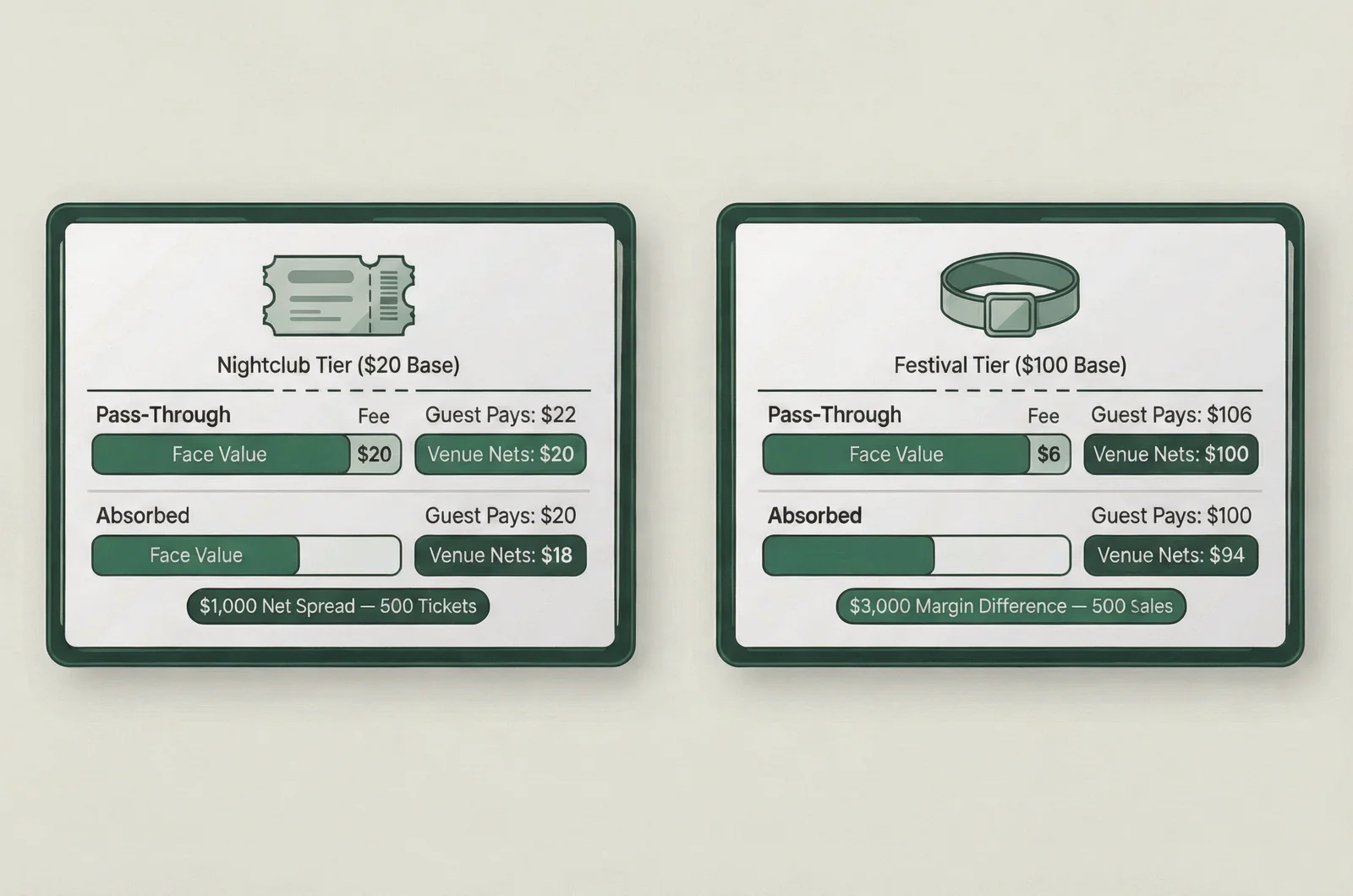
Both assume one ticket per order and a fixed combined transaction cost per ticket. Figures exclude tax, refunds, disputes, subscriptions, and event operating costs.
A $20 nightclub ticket with a $2 transaction cost
Suppose your venue sells 500 tickets. Compare three ways to price the same admission:
| Pricing approach | Guest pays before tax | Venue retains per ticket | Proceeds from 500 tickets |
|---|---|---|---|
| $20 face value plus $2 fee | $22 | $20 | $10,000 |
| $20 price with fee absorbed | $20 | $18 | $9,000 |
| $22 inclusive price | $22 | $20 | $10,000 |
Absorbing the fee costs $1,000 at unchanged sales volume.
To retain at least $10,000 from tickets, the venue would need to sell 556 tickets at $18 retained each. That produces $10,008.
If paid capacity is 500, extra ticket volume cannot close the gap. You would need a higher price, lower transaction costs, or additional contribution elsewhere.
The two $22 options produce identical proceeds under these assumptions. Whether guests prefer one presentation requires measurement.
A $100 festival ticket with a $6 transaction cost
Suppose a festival sells 1,000 tickets.
Passing through the hypothetical $6 cost means guests pay $106 and the organizer retains $100 per ticket: $100,000 total.
Absorbing it within a $100 price leaves $94 per ticket: $94,000 total.
The organizer would need 1,064 sales at $94 retained each to exceed the original proceeds. That produces $100,016, requiring about 6.4% more tickets.
The larger dollar fee creates a smaller proportional hurdle than the nightclub example. The relevant measure is the fee relative to what remains after absorption.
Group purchases need an order-level calculation
Replace these simplified assumptions with your actual charges before setting prices.
A fixed charge per order behaves differently from a charge per ticket. Spread an order charge across the number of tickets purchased, then add applicable percentage costs.
Use your actual basket mix. A festival with frequent group purchases should calculate proceeds for representative group orders as well as single-ticket orders.
Measure the sales lift absorption must earn
Absorbing fees earns its place when the resulting sales or attendance improve contribution enough to cover the reduction per ticket.
For ticket proceeds alone, calculate:
Required sales when absorbing = sales when passing fees through × proceeds per ticket when passing fees through ÷ proceeds per ticket when absorbing.
This assumes the transaction costs and ticket prices used in the calculation remain consistent.
Compare completion rates with retained proceeds
Return to the nightclub example. Suppose 100 checkout starts produce 60 purchases when guests pay $22.
At $20 retained per sale, those purchases generate $1,200 before other costs.
With fees absorbed, the venue retains $18. It needs a completion rate of about 66.7% to generate the same proceeds from 100 starts.
That is a 6.7 percentage-point increase, or roughly an 11.1% relative lift. A small improvement would not cover the fee.
Track paid orders, tickets per order, guest totals, transaction deductions, and refunds together. Your ticket sales report can be a starting point for reconciliation; confirm which figures it includes.
If the lower price appears before checkout, also track purchases per event-page visitor. Checkout starts miss guests who leave earlier.
Include attendance contribution without counting gross bar sales
For a nightclub or beach club, additional attendance may generate contribution beyond admission.
Use spending after the associated variable costs. Gross bar revenue overstates what is available to cover an absorbed ticket fee.
Compare similar events, audience segments, and sales windows. Changes in the lineup, promotion, or weather can muddy the result.
A useful fee calculator would accept ticket price, transaction charges, basket size, capacity, and completion rate. It would show retained proceeds and the additional sales needed to break even.
Price refunds and disputes into both options
Passing fees to guests does not establish what happens to the underlying costs when an order is refunded. That depends on the agreements governing the transaction.
If your processor retains an original processing charge after a refund, include that expense under either model. If a platform returns its fee, account for that separately.
For each refund scenario, record three amounts: what the guest paid, what the guest receives back, and what outside parties retain.
A full cancellation and a partial refund can produce different calculations. Refunding one ticket from a group order also raises the question of how any order-level charge is allocated.
Before publishing, document:
- The refund amount for a fully canceled order.
- The treatment of fees on a partial refund.
- Who authorizes exceptions and records their cost.
- The records staff should keep for a disputed payment.
Check the complete ticket refund workflow against your written policy. Confirm the amount returned rather than assuming a refund action reverses every charge.
For disputes, keep the purchase terms, receipt, guest communications, and available admission records together. Include any dispute charges specified in your agreements when reviewing event contribution.
Evaluate results after the relevant refund period, too. An event can look healthy immediately after sales close and retain less once cancellations are processed. Compare both fee models over the same reporting window and record unresolved disputes separately from settled costs.
Match the fee model to the night you are selling
The stronger fee model depends on whether your constraint is demand, capacity, or retained contribution. Choose against that constraint before debating which checkout looks cleaner.
Recurring nightclub nights with room to fill
Absorption is worth testing when spare capacity exists and the lower total could attract additional paying guests.
The limitation is the cost applied to every ticket sold, including tickets guests would have purchased anyway. Those existing sales must be included in the calculation.
Use total event contribution as the deciding measure. Track paid attendance and spending contribution alongside ticket proceeds.
If absorption produces little additional attendance, retain the fee recovery or adjust the inclusive price for the next comparable event.
Festivals with firm budgets and multiple tiers
Recovering transaction costs is a reasonable starting point when the event budget depends on retaining a particular amount per ticket.
An inclusive price can also recover those costs. The budget question is the retained amount after deductions.
Calculate each tier separately. A fixed fee consumes a larger share of a low-priced early release than a higher-priced final release.
The limitation of passing fees through is the higher guest total at an unchanged face value. Compare that total against your sales assumptions, and check group-order economics before approving the budget.
Premium lounge and beach club events
An inclusive ticket price may fit an event where the operator wants one clear amount across the event page, receipt, and door conversation.
That presentation does not require accepting a lower margin. Build the intended contribution into the advertised price and calculate costs from that amount.
Where admission, table deposits, and minimum spends coexist, explain each separately. A deposit credited toward spending has a different purpose from a ticket transaction charge.
Before launch, give reservations and door staff the same written explanation of what each payment covers. Record fee questions during check-in so the next pricing review includes guest reactions as well as sales totals.
The platform’s fee model changes the cost
The platform’s commercial model changes how much cost you need to recover, regardless of who pays it.
Separate sales commissions, payment processing, and subscription charges when comparing venue software costs. Removing a percentage commission changes the calculation, while remaining charges still need to be counted.
VenueStack’s stated model as of October 2026 is one plan with every feature, plus 4% processing fees, at least $2 and at most $50 (C$2.50–C$50, €2–€50, £1.50–£50) on each paid order, which the venue can pass to guests at checkout. Confirm its current venue pricing terms alongside the payment-processing terms that apply to your account.
For the venue’s full software budget, divide subscription costs across expected paid tickets over the same period. Use a realistic sales forecast rather than a sellout assumption.
For a test of fee absorption within the same platform, hold unchanged subscription costs constant. The immediate question is whether changing the guest’s price improves contribution enough to cover the transaction costs you absorb.
These are different calculations. One compares platform economics; the other compares guest pricing choices.
Lower transaction costs reduce the amount absorption must earn back. Enter those costs into the nightclub or festival calculation before deciding whether the venue can absorb them. A platform label alone cannot establish which guest price will produce the strongest result.
Questions to settle before tickets go on sale
Fee allocation also affects split charges, ticket tiers, and the explanation staff give guests. Resolve these details before publishing prices.
Can the venue absorb part of the fee?
Yes, if the ticketing setup supports that arrangement. Calculate the venue’s contribution and the guest’s total explicitly.
For example, sharing the hypothetical $2 nightclub fee equally would leave the guest paying $21 and the venue retaining $19. That sits between full absorption and full pass-through.
Check how percentage charges affect the final amount before treating a partial contribution as a fixed saving.
Will a separate fee create complaints at the door?
You cannot predict that from the fee label alone. Check whether the guest saw a consistent total before paying and whether the receipt explains the purchase.
Give staff a short, factual explanation and a route for billing questions. Track fee complaints per 100 check-ins, plus time spent resolving them.
Compare those records with refunds and repeat purchases before attributing guest sentiment to the pricing model.
Should early-bird and standard tickets use the same rule?
Consistency makes the price ladder easier to understand, but calculate the economics of each tier.
A low early-bird face value can look attractive while leaving little contribution after absorbed costs. Compare the guest totals across releases as well.
Map the tiers in your ticket type setup, verify which fee rules your system supports, and inspect a complete checkout for each tier before sales open.