For venue operators weighing early bird ticket pricing pros and cons, the central question is how much margin to trade for an earlier commitment. Presales put cash in the account before event night and give the team an initial demand signal. The cost is the discount, including discounts given to guests who would have paid full price. These five models suit different situations. The ranking below favors controlled discount exposure, clear sales rules, and practical use across public events.
Protect the ticket margin before rewarding early buyers
A useful early release needs a defined job. That might be securing the first bookings for a new event, bringing forward cash for production, or rewarding returning guests. Choose the job before choosing the discount.
This ranking puts limited-quantity releases first because the operator can set the maximum ticket revenue surrendered. Timed tiers follow because they create a published buying schedule. Bundles and member pricing need a suitable audience or operating setup. A broad percentage discount comes last because its total cost can remain uncertain until the window closes.
Three measures matter:
- Revenue per paid ticket, after separating admission from deposits, spend credits, and other package components.
- Sales pace at the same point before comparable events, with final sales checked afterward.
- Attendance by ticket type, using scans against valid tickets after refunds and cancellations.
All numbers below are hypothetical planning examples. The ranking reflects pricing mechanics, with no measured performance benchmarks for sellout speed or attendance.
Use one working example throughout: an event with 500 sellable admissions and a regular ticket price of $40. A full-price sellout would produce $20,000 before fees, taxes, and refunds. That is a comparison baseline, not a forecast that all 500 tickets would sell.
Five ways to structure the early release
Each structure changes who receives the discount, when they can buy, or how much discounted inventory exists. Those controls determine the financial exposure.
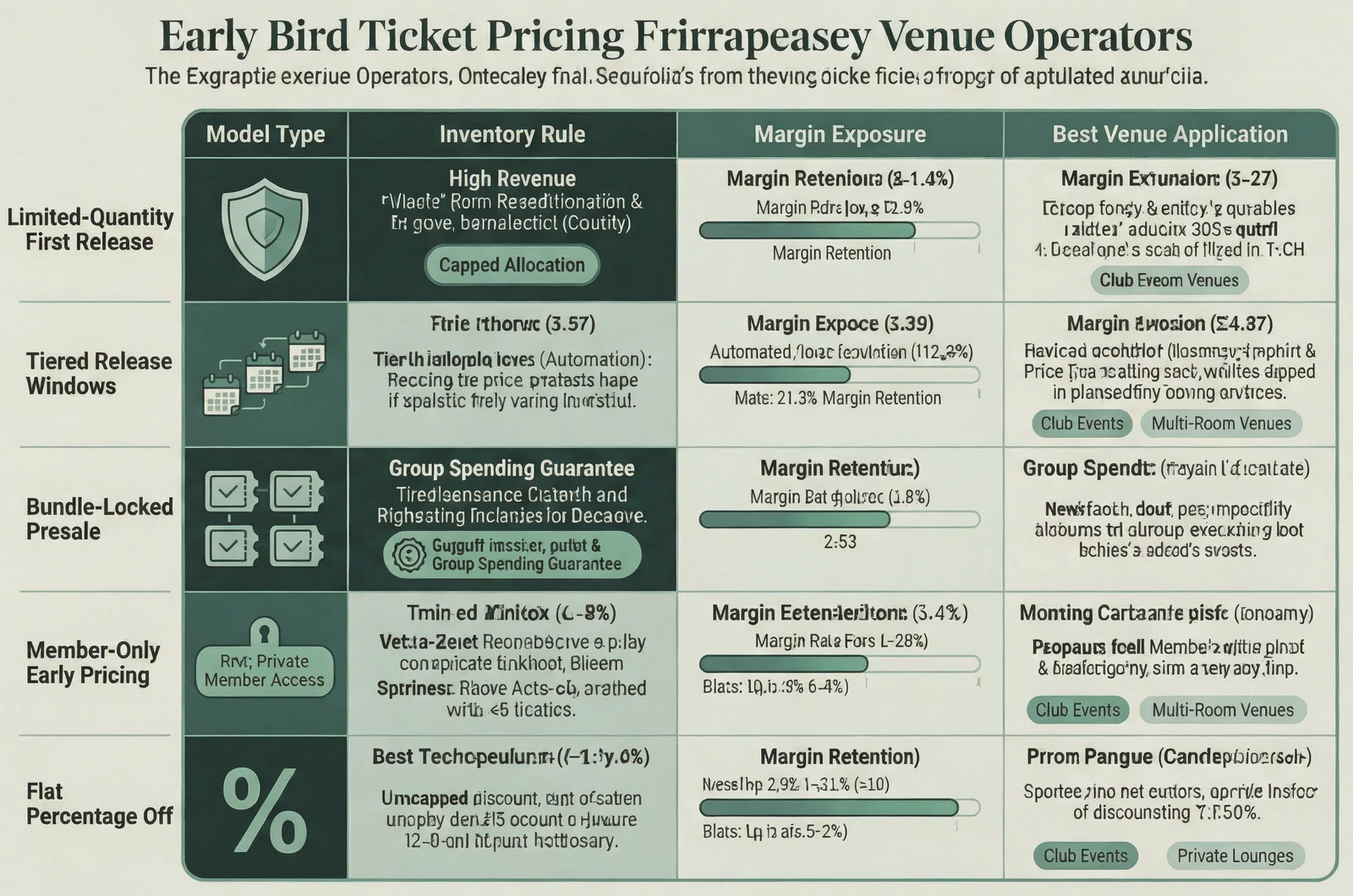
| Default order | Model | Discount control | Early sales trigger | No-show assessment |
|---|---|---|---|---|
| 1 | Limited-quantity first release | Fixed maximum when inventory is capped | A finite allocation | Requires attendance data |
| 2 | Tiered release windows | Depends on sales within each window | Published price increases | Requires attendance data |
| 3 | Bundle-locked presale | Depends on package allocation and costs | A package available early | Check whole-group attendance |
| 4 | Member-only early pricing | Depends on eligibility and purchase limits | Restricted access | Compare member ticket cohorts |
| 5 | Flat percentage off | Uncertain without a quantity cap | A closing deadline | Low price alone proves little |
The order suits a one-off public event. A recurring members’ night or a table-led beach club may reasonably put another structure first.
Limited-quantity first release
A capped first release suits an operator who wants early commitments while keeping the discount budget predictable. Set aside a specific allocation at a lower price, then move to regular admission when it sells out.
In the working example, release 100 tickets at $32 and keep 400 at $40. If every ticket sells, admission revenue is $19,200, or $38.40 per paid ticket. The discount costs $800 against the full-price sellout baseline.
Its strongest attribute is the clear limit. The operator knows the maximum exposure before opening sales. Guests also have a concrete reason to decide: the cheaper allocation can run out.
The limitation is that allocation exhaustion says little about demand for the remaining tickets. One hundred discounted sales could include regulars who intended to attend anyway. A fast first release therefore does not establish that the event will sell out faster overall.
Attendance remains a separate question. Track whether those early buyers actually scan in, particularly when the first release happens well ahead of the event.
Start here when you lack reliable demand history and can afford a defined concession. Keep the allocation inside the event’s shared capacity, and review the ticket type setup before publishing. Stop the release at its announced limit.
Tiered release windows
Timed tiers suit events with a longer sales runway and a marketing calendar built around clear deadlines. The price rises on announced dates, whether or not the previous window reaches a particular volume.
Suppose the example event sells 100 tickets at $32, 150 at $36, and 250 at $40. Gross admission revenue reaches $18,600, or $37.20 per paid ticket. The concession against the baseline is $1,400.
Those quantities are assumed sales, not automatic caps. A date-based window can sell more discounted tickets than expected unless it also has an inventory limit. That distinction explains why its revenue protection ranks below a capped first release.
Published increases can bring decisions forward. They also create an operating obligation: sales pages, promoter messages, and checkout prices need to agree. Repeatedly extending the cheapest window weakens the reason to meet the next deadline.
Earlier purchases create a longer interval during which guests’ plans can change. The size of any attendance effect is unknown until the venue measures it.
Use timed tiers when scheduled sales updates serve the event. In your ticketed event setup, verify dates, time zones, and the transition between prices. Add a quantity ceiling if the discount budget must stay fixed.
Bundle-locked presale
Bundles suit venues where admission connects to a table, reserved area, or prepaid spend. The early benefit applies to a package, so the operator must judge both its admission yield and its service cost.
For the working venue, consider a four-person package sold for $224. It includes $80 of spend credit, which leaves $144 allocated to admission for planning purposes. Admission yield is $36 per guest.
The full $224 cannot be treated as ticket proceeds while the spend credit is counted again when redeemed. The package also brings fulfillment costs, which belong in its margin calculation.
Its standout attribute is that the booking can establish group size and a reservation commitment together. That may suit a lounge or beach club better than selling four discounted admissions separately.
The limitation is operational detail. Package terms must explain how many people are admitted, what the credit covers, and how guests enter if they arrive separately. A paid group booking still needs individual attendance tracking; one scanned organizer does not establish that all four guests arrived.
Choose this structure when the package matches how guests already book. Review ticket and table packages alongside the floor allocation. Count every included admission once, and keep package credit separate from ticket yield.
Member-only early pricing
Restricted early pricing suits recurring events with an identifiable returning audience. Eligibility might depend on a defined membership or customer group, with clear limits on purchases.
Suppose 50 eligible guests buy at $32 and the other 450 admissions sell at $40. The sold-out event generates $19,600, or $39.20 per paid ticket. That is a $400 concession against the baseline.
The favorable result comes from the small discounted allocation. Membership status itself does not create the higher yield. If eligible buyers can purchase unlimited discounted tickets for friends, exposure can grow well beyond the intended audience.
The main advantage is selective access. An operator can reward a defined group without publishing the lower price to every prospective buyer.
Its limitation is reach. Existing customers may have attended at full price, so the venue should separate a retention reward from an attempt to generate additional demand. There is also no basis for assuming members will attend more reliably without checking their scans.
Use member pricing when the reward has a clear purpose and eligibility is practical to administer. Keep any existing membership fees outside the event’s incremental ticket calculation. Set both the discounted inventory and the per-buyer allowance before access opens.
Flat percentage off
A percentage discount suits a simple, short presale where the operator accepts uncertainty about how many guests will receive it. The rule is easy to communicate: buy before the deadline and pay a set percentage less.
At 20% off a $40 ticket, the early price is $32. If 300 guests buy early and 200 pay the regular price, total admission revenue is $17,600. Average ticket yield falls to $35.20.
That is $1,600 below the capped first-release example, despite both events selling all 500 tickets. The difference comes from giving 200 additional buyers an $8 discount.
The structure’s strength is simplicity. Its weakness is that a successful early campaign can also expand the concession. A deadline controls duration; it does not control the number of discounted purchases.
Sales may cluster before the cutoff, but that does not prove total demand increased. Some guests may simply have moved their purchase earlier. Attendance also needs its own evidence: a cheaper ticket is neither proof of weak commitment nor a guarantee of turnout.
Choose a flat discount when simplicity serves the event and the potential concession fits the budget. If the exposure is too large, cap the allocation. That turns the promotion into a limited first release.
Measure the extra sales needed to pay for the discount
An early discount earns its place when the resulting cash timing, additional sales, or customer reward justifies its cost. Start with a comparable sales baseline so the team can tell those outcomes apart.
Calculate the additional tickets required
Suppose the working venue would otherwise sell 400 tickets at $40. That produces $16,000 in admission revenue.
If it sells the same 400 admissions with 100 priced at $32 and 300 at $40, revenue falls to $15,200. The early release needs 20 additional sales at $40 to recover the $800 concession.
That is the admission-revenue break-even point. It excludes costs associated with serving those extra guests, payment fees, and any change in on-site spending. Contribution margin, the amount left after relevant costs, requires those amounts too.
The calculation also depends on available capacity. At a full-price sellout, extra admissions cannot recover the discount because there is no remaining sellable inventory. The operator must instead justify the concession through another benefit, such as earlier cash receipts.
A useful calculator would take expected full-price sales, discounted quantity, both prices, and incremental cost per guest. It could show the additional admissions required and whether the remaining allocation can accommodate them.
Keep the assumptions visible. Changing the expected full-price sales figure can change the decision.
Reconcile purchases with attendance and costs
After the event, compare ticket types using paid quantity, admission proceeds, refunds, and valid scans. Use the same denominators for every release.
Revenue per paid ticket measures pricing yield. Attendance rate measures how many valid ticket holders arrived. Revenue per attendee answers another question and can rise when absent guests leave unused tickets behind. It therefore needs the attendance count beside it.
Use ticket sales reports alongside check-in records. For bundles, record how many included guests attended and how much prepaid credit was redeemed.
Include software costs in the event budget. If VenueStack is under consideration, compare its venue software pricing with the expected sales volume and other event costs.
For the next release, change one major pricing variable at a time. Record differences in lineup, event date, and marketing spend alongside the results.
Questions to settle before tickets go live
Presale terms affect guest expectations and the door team’s work. Resolve these points before announcing the first price.
How large should the discount be?
Start with the maximum concession the event can absorb and the size of the early allocation.
If the working venue accepts an $800 concession across 100 tickets, the available discount is $8 each. On a $40 admission, that equals 20%.
This sets a financial boundary. It does not establish which discount will change buying behavior. Compare results with similar events and record how much additional volume the release produced, if any.
Should the cheapest price be extended?
Decide the closing rule before launch. A quantity release closes at its allocation; a timed release closes at its stated deadline.
If sales lag, inspect the event proposition, checkout, and audience response before extending the discount. A cheaper price cannot resolve every reason someone hesitates to buy.
When the terms change, update every sales channel. Make the revised end date or allocation clear, and retain the original figures for the event review.
Can presales reduce no-shows?
Payment confirms a purchase, but attendance still needs measurement. A buyer’s plans can change between the sale and event night.
Compare valid scans with valid tickets for each price type and purchase window. For group packages, count individual arrivals. Keep refunds and cancellations distinct from guests who held a valid ticket but did not attend.
Give every buyer clear arrival information, admission conditions, and any applicable transfer or refund terms. Judge the pricing model’s attendance record from the check-in data.