
For operators considering timed entry ticketing to reduce door queues, the practical question is whether scheduled arrivals will spread demand enough to shorten the wait. As of November 17, 2026, the evidence available for this update does not establish a named nightclub or festival rollout, an adoption rate, or measured queue reductions. Claims of a new industry shift therefore remain unverified.
The operating case still deserves scrutiny. An arrival window gives a venue a way to divide expected demand across time. Its effect depends on guest behavior, admission speed, staffing, and the space available inside. The following analysis examines those conditions and the evidence that would demonstrate a useful result.
The club-door adoption claim needs named examples
A ticket with an arrival window establishes a booking rule. Demonstrating a change in nightlife operations requires more detail: who introduced it, when it started, which guests it covers, and what happened at the entrance.
An early-entry discount, for example, encourages arrival before a deadline. A scheduled ticket assigns a period for arrival. Those arrangements can produce different results. A deadline may concentrate guests immediately before the cutoff, while several windows may distribute them across a longer period.
The distinction matters when assessing reports about staggered admission. A venue selling several ticket categories has not necessarily introduced separate arrival windows. An event advertising earlier admission has not necessarily measured shorter queues.
A credible example would identify the event dates, ticket conditions, window allocations, and door policy. It would also explain whether the arrangement covered all admissions or only a portion of them.
Without those details, operators cannot tell whether the reported change concerns pricing, scheduling, or actual entrance performance. The first reporting threshold is a named event with a dated admission policy.
The queue calculation depends on the busiest minutes
Scheduled entry can help when it changes the relationship between arriving guests and people admitted. The relevant measure is the arrival curve: how many people reach the entrance during each short interval.
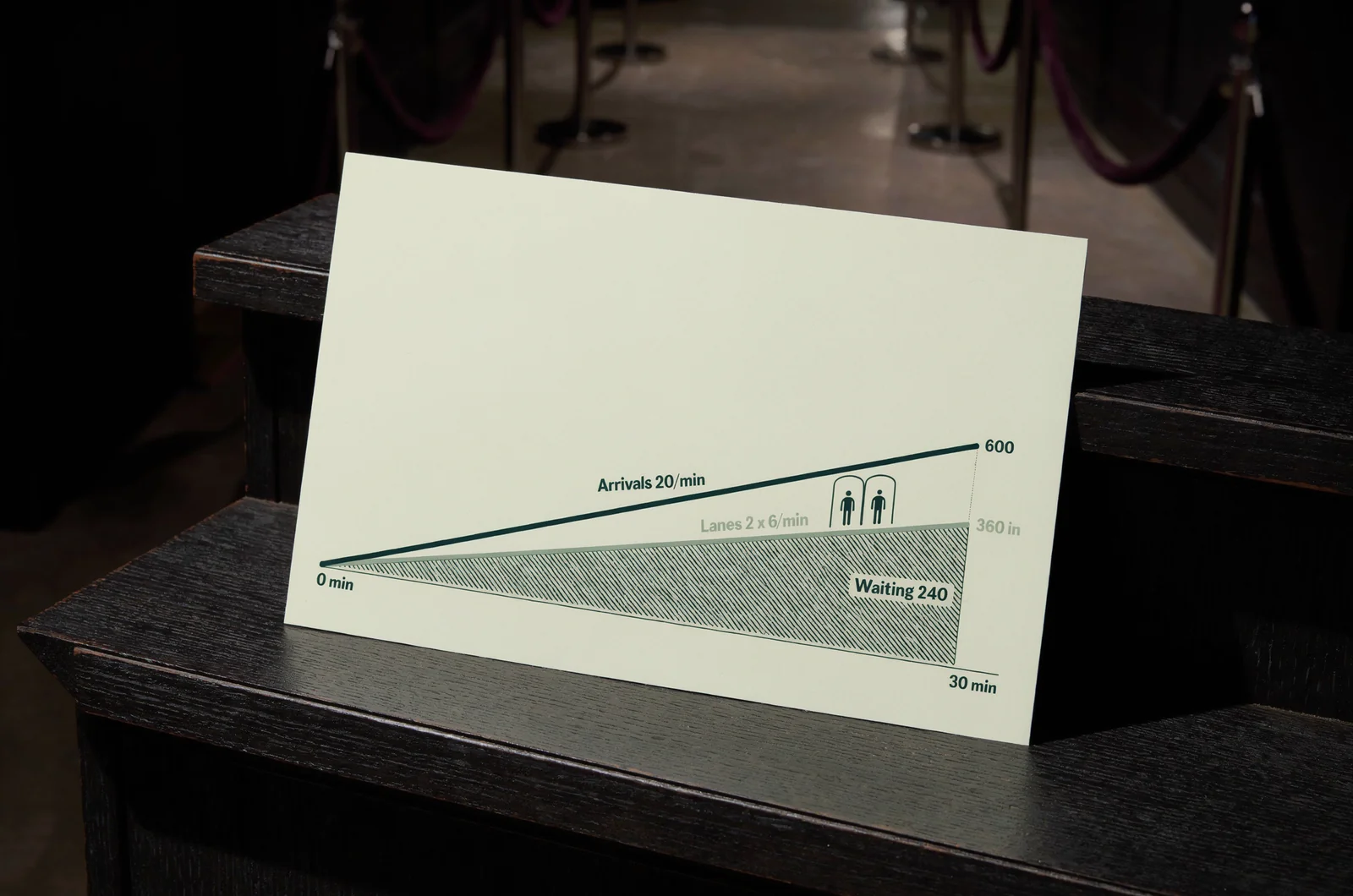
A hypothetical door shows the constraint
Consider a hypothetical event where 600 guests arrive evenly over 30 minutes. Assume two admission lanes each complete entry for six people per minute throughout that period.
Together, the lanes admit 12 people per minute, or 360 people in half an hour. Arrivals average 20 people per minute. Under those assumptions, 240 guests remain waiting after the first 30 minutes.
If arrivals then stop and processing continues at the same rate, clearing that remaining queue takes another 20 minutes. These figures are an arithmetic illustration.
Now divide the same 600 guests into three groups of 200, with each group assigned a separate 30-minute window. Average demand falls to about 6.7 arrivals per minute across 90 minutes. The assumed entrance capacity remains 12 per minute.
That creates room to absorb uneven arrivals. It also depends on guests following their assigned windows.
A window can contain its own rush
A 30-minute slot does not mean guests arrive evenly throughout it. If all 200 guests reach the door during its first 10 minutes, demand again averages 20 people per minute.
At the assumed admission rate, 120 people enter during those 10 minutes and 80 remain waiting. The schedule has created a smaller surge, but a surge remains.
This is why hourly attendance totals can conceal the problem. Five- or ten-minute arrival counts reveal whether guests are spreading out or clustering at window boundaries.
The companion discussion of faster check-in flow addresses the processing side of that relationship. For a timed-entry claim, both sides need measurement: arrivals per interval and completed admissions per interval.
A ticket scan captures only part of admission
Timed windows change expected demand. Their value also depends on how quickly the whole entrance process moves people inside.
Completed admissions matter more than scanner speed
A barcode can validate successfully while the guest still waits for another admission step. Ticket lookup, bag inspection, wristband collection, and questions about booking conditions can each occupy time or space.
The useful throughput measure is people who complete admission through a lane per minute. Counting successful barcode reads alone can overstate the entrance’s capacity.
Group bookings complicate the comparison further. One scan might validate several people, while another transaction requires several separate tickets. Reports need a consistent unit, preferably people admitted, alongside transaction counts.
Any analysis of mobile ticket scanning practices therefore needs the surrounding process. A scanner’s response time and a lane’s admission rate answer different questions.
Staffing changes can obscure the result
Suppose a venue introduces arrival windows and adds another staffed lane on the same night. A shorter queue would be encouraging, but the separate contribution of scheduling would remain uncertain.
The same problem arises if staff receive new training, signage changes, or a supervisor starts resolving ticket exceptions away from the main line. Each change can affect waiting time.
For an operator assessing the result, staffing records belong beside arrival and admission counts. The record should show how many lanes were operating, when each opened, and which tasks each handled.
That detail also exposes a possible scheduling mismatch. If staff arrive after the first ticket window begins, the venue has sold access to a period its entrance may be unable to support. A meaningful performance report includes actual lane opening times.
Club and festival windows face different pressures
The same ticket rule can behave differently at a nightclub and a festival because the reasons guests arrive together can differ.
Club arrivals may follow the night’s main attraction
A club’s scheduled windows may compete with the time guests want to see a particular performance or meet their group. If several friends hold different slots, they may still choose one arrival time.
Table reservations, guest lists, and walk-up admissions can add demand outside the scheduled ticket allocation. A report limited to timed-ticket holders would miss those arrivals.
VenueStack combines ticketing, table bookings, and guest lists in one system. Those records can provide a fuller starting point for expected attendance, although reservations alone cannot establish when each guest will reach the door.
The operational question is whether all admission routes appear in the arrival forecast. Guest list door management becomes relevant when listed guests share processing space with scheduled ticket holders.
Festival arrivals may be shaped before the gate
For a festival, a transport drop-off or shuttle arrival could deliver many guests at once. Individual ticket windows would then interact with a shared transport schedule.
A guest’s journey may also include several waiting points before ticket validation. A shorter scanner queue could coincide with a longer wait at an earlier checkpoint.
These differences make festival versus nightclub ticketing a useful distinction when interpreting results. A reported improvement should identify where waiting began, where it ended, and which admission routes were measured.
Arrival slots leave an occupancy question open
Timed admission can improve the forecast of incoming demand. Tracking how many people are currently inside requires additional information.
An arrival window usually schedules entry
A guest assigned an early arrival period may remain inside through several later windows. Unless the ticket also establishes a departure arrangement, the next window does not imply that earlier guests have left.
This creates two separate planning limits. One concerns how many arrivals the entrance can process during a period. The other concerns how many people can be inside at once.
A schedule may fit the first limit while leaving the second unresolved. Selling equal allocations across successive windows does not, by itself, account for guests who stay.
For operators reviewing venue capacity tracking, the relevant records include admissions, departures, re-entry, and movement between separately monitored spaces. Booked arrival times supply only one part of that picture.
Attendance reporting needs clear definitions
VenueStack includes check-in and event reporting. Those functions are relevant to comparing expected guests with recorded attendance.
A current occupancy figure still depends on the events the venue records. If departures are missing, cumulative check-ins cannot establish how many guests remain inside. If re-entry counts as a fresh admission without an associated departure, totals need careful interpretation.
The same distinction applies to a multi-room venue. A count at the building entrance cannot establish how guests are distributed between rooms.
A useful timed-entry report should define every number it presents: booked guests, admitted guests, cumulative attendance, or current occupancy. Each answers a different operating question.
The entry window needs a clear promise to guests
An arrival schedule changes the terms guests must understand before traveling. Unclear conditions can create disputes at the same entrance the schedule is meant to relieve.
Does a slot guarantee immediate admission?
An arrival window identifies when a guest is expected or permitted to arrive. Any promise about waiting time needs separate support.
If the ticket simply assigns a period, the wording should explain how admission works within it. Guests also need to know whether arriving at the beginning, middle, or end affects their place in line.
The distinction becomes especially visible at a window boundary. Someone reaching the queue before the cutoff may complete admission afterward. The policy needs a clear definition of arrival.
What happens when someone arrives late?
Late-arrival treatment affects both the guest and the following window’s demand. Moving every late guest into the next period can increase its workload beyond the original allocation.
Possible policies have different consequences, including waiting for available space or using a defined grace period. An article reporting a venue’s results would need to identify the actual rule.
Staff also need a consistent way to handle guests whose delay occurred within an earlier venue-controlled queue. Otherwise, the recorded lateness may describe processing time rather than guest behavior.
Can a group arrive together?
A group may hold tickets across several windows, particularly when members book separately. Letting everyone enter together changes the planned distribution of arrivals.
Splitting the group can create a different service problem. The booking terms should explain how shared reservations, separate purchases, and table guests interact with timed admission.
A performance claim needs to disclose those exceptions because they change how closely actual arrivals follow the sold schedule.
A credible result would connect the schedule to the wait
The next meaningful development would be a dated, attributable result that shows how timed admission changed entrance performance under stated operating conditions.
Comparable nights need comparable records
A before-and-after report should identify event attendance, scheduled windows, staffing, lane availability, and the method used to measure waiting time.
Event context matters too. A quieter program or a different audience could change arrivals independently of the ticket rule. Where conditions differ, the report should explain those differences.
Average waiting time is useful, but it can conceal a difficult peak. An operator would also benefit from the longest observed wait or another measure that shows what happened during the busiest periods.
The starting point of the measurement needs to remain consistent. Timing from the scanner desk on one night and from the back of the outdoor queue on another would produce an unreliable comparison.
A shorter line also needs interpretation. It could reflect faster admission, fewer arrivals, or guests waiting elsewhere.
The evidence should follow guests through the entrance
The strongest operating record would connect assigned windows with actual arrival times, completed admissions, exceptions, and occupancy.
That would show whether guests followed the schedule, whether each lane kept pace, and whether delays moved to another checkpoint. It would also reveal whether earlier arrivals accumulated inside during later windows.
A useful interactive tool would be an arrival-load estimator that compares expected guests per window with measured admissions per minute and available staffed lanes. Its output should remain a planning scenario, with assumptions visible.
Commercial effects belong in the assessment as well. An operator may want to compare missed windows, booking changes, complaints, and attendance alongside waiting time. A shorter queue would answer only part of that review.
Until a named club or festival publishes comparable results, the claim remains an operating proposition. The evidence to watch is specific: dated ticket terms, actual arrival counts, staffed-lane throughput, and measured waits from a consistent starting point.