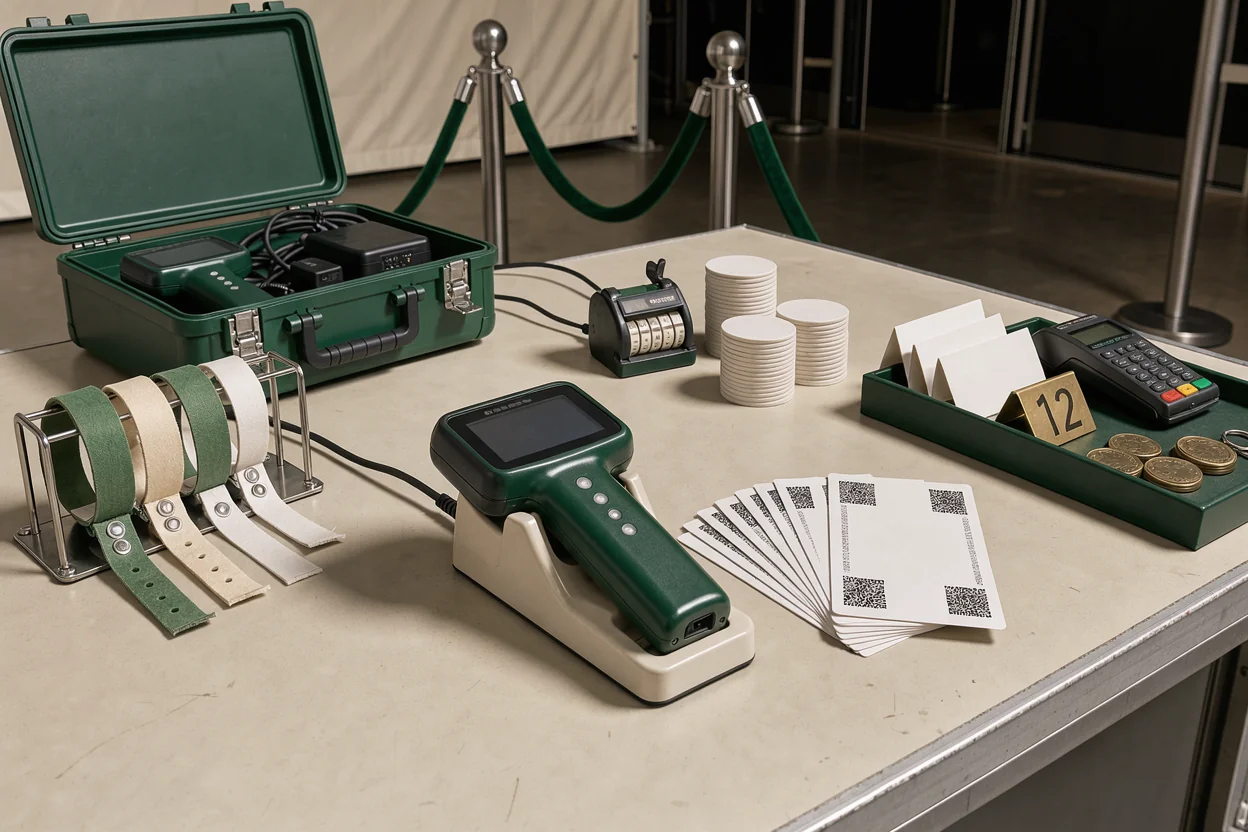
Comparing festival vs nightclub ticketing requirements starts with the failure you can least afford. A festival may need admission to continue across several gates during a connection outage. A nightclub may need a host to seat a table party, confirm its deposit, and account for guests arriving separately. Both sell entry, but their operating requirements can pull software in different directions.
This ranking orders eight requirements by the consequences of failure during an event, then by how difficult recovery becomes once guests arrive. Scores are editorial priorities, not measured failure rates or vendor ratings. Five signals admission-control exposure; lower scores place more weight on administrative and financial consequences.
Treat the order as a starting point. A table-heavy club should move table management above wristband redemption. For each requirement, the buying question is the same: can the system complete your actual workflow under pressure, and can staff recover when something goes wrong?
1. Capacity controls across every admission channel
Capacity earns a risk score of 5/5 because disconnected inventory can create admission promises the operation cannot honor.
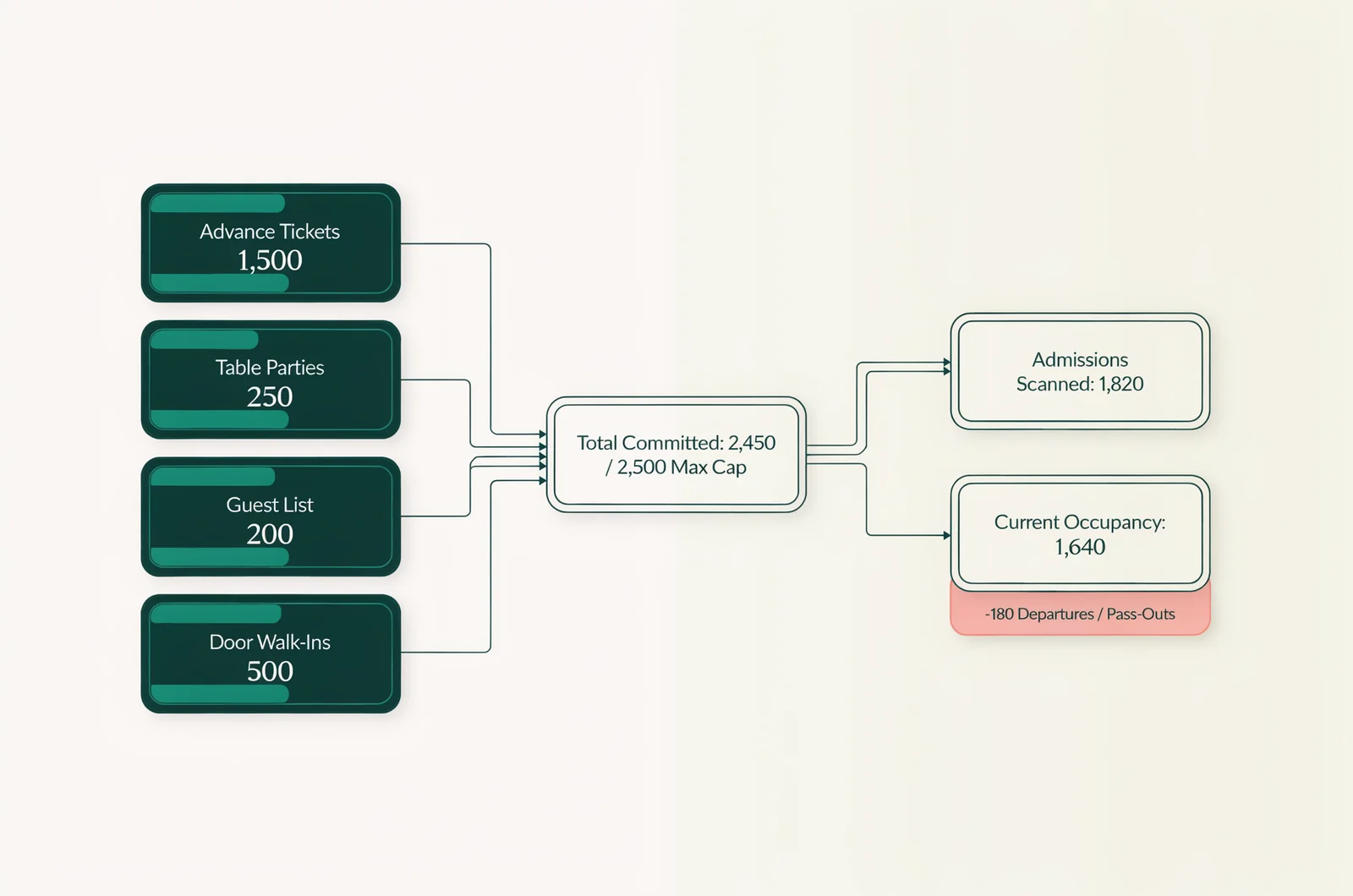
A festival may sell day passes, weekend passes, premium access, and separate activities. A nightclub may combine advance tickets, walk-ins, guest lists, and table parties. Each format needs a defined relationship between those allocations and the number of people expected inside.
Tickets sold, admissions recorded, and current occupancy are different counts. Re-entry and departures can change occupancy without changing sales. A table reservation may represent several guests, so counting the booking as one admission gives staff an incomplete picture.
This requirement belongs first for operators with multiple sales channels, entrances, or admission categories. Review capacity planning controls against the exact inventory rules your event needs.
The limitation is data capture: software cannot maintain a useful live count if departures, complimentary guests, or manual admissions go unrecorded. It also cannot replace physical crowd management.
Make this a purchase condition. Ask for a demonstration in which advance sales, table allocations, and door admissions draw from the intended shared limit. Then attempt a simultaneous purchase for the last available places and inspect what each staff screen shows.
2. Offline admission with a defined sync plan
Offline operation also scores 5/5 because a connection failure can leave staff unable to validate entry or trust admission records.
A festival with separated gates should establish what each device stores locally and when it receives updates. A nightclub should ask the same questions if admission depends on venue Wi-Fi or cellular service.
The important distinction is between scanning without internet and sharing scan results without internet. If two disconnected devices cannot exchange updates, each may lack the other device’s latest admissions. A successful offline scan alone does not prove duplicate protection across entrances.
This requirement fits multi-gate events and any venue without dependable connectivity. Use offline QR check-in failures to frame the operating questions, then have the supplier demonstrate its own behavior.
Its limitation is the fallback design. A downloaded guest list can become stale after a refund, transfer, or late purchase. Staff need an explicit rule for records they cannot verify.
Require a disconnected rehearsal using multiple devices. Present the same ticket twice, introduce a purchase made after the download, restore connectivity, and inspect the resulting records. Assign one person authority to resolve conflicts before doors open.
3. Peak arrival throughput at the gate
Arrival throughput scores 4/5 because a workable admission process can still fail when guests arrive faster than staff can process them.
For a festival, assess each entrance and any separate credential pickup lane. For a nightclub, include guest-list searches, table-party checks, and payment questions in the arrival workload. The relevant measure is completed admissions per minute under the intended staffing plan.
For illustration, suppose 900 guests arrive within 30 minutes. The operation must complete 30 admissions per minute across its active lanes just to match incoming demand. That calculation leaves no allowance for exceptions or an uneven arrival pattern.
This requirement deserves extra attention when a headline act, timed opening, or afterparty concentrates arrivals. Review mobile ticket scanning operations alongside device placement, staff roles, and exception handling.
The limitation is that scan speed measures only one step. Identity checks, screening, wristband fitting, and guest conversations may determine the actual pace.
Choose a system that makes ordinary admissions brief and sends exceptions to a separate resolution point. Rehearse with valid tickets, unreadable screens, duplicate scans, and guests searching for confirmations. Record completed admissions and unresolved cases over the same timed interval.
4. Wristband redemption and re-entry control
Wristband redemption scores 4/5 when a festival exchanges tickets for credentials that guests will use again.
The system needs to distinguish the original purchase, credential issuance, and subsequent entry. A weekend ticket should have a clear redemption status after staff issue the wristband. A replacement needs a recorded relationship to the original credential.
For a nightclub using single-entry tickets, that workflow may add unnecessary steps. Where the venue uses stamps or wristbands for re-entry, staff still need an agreed process for departures and returns.
This requirement fits multi-day festivals, events with access zones, and operations where the admission credential changes at arrival. Map the door check-in flow from ticket presentation through credential handover before choosing hardware.
The limitation is that a wristband’s appearance or technology does not establish the permissions behind it. Staff need to know which days, areas, and return visits it permits. Lost credentials also create an exception that someone must own.
Require a demonstration of issuance, repeat presentation of the original ticket, replacement, and re-entry. If your event has one entry period and no continuing credential requirement, keep wristband management below scanning reliability on the buying list.
5. Table minimums, deposits, and party arrivals
Table management scores 4/5 because a ticket transaction leaves several bottle-service questions unanswered.
A nightclub reservation needs a table assignment, party allowance, payment record, and minimum-spend agreement where applicable. A festival selling hospitality tables or cabanas may need similar controls alongside its general admission operation.
The distinction between a deposit and a minimum matters. In a hypothetical booking, a $200 deposit against a $1,000 minimum leaves staff needing to understand how that payment applies. The reservation should also state which charges count toward the agreed minimum. Those terms must match what the guest received.
This requirement fits clubs, lounges, beach clubs, and festivals with reserved hospitality inventory. Connected ticket and table sales can help staff see the relationship between admission and a reservation.
Its limitation is settlement scope. Reservation software may record a deposit while a separate point-of-sale system holds spending during service. Confirm which system owns the remaining balance and how staff reconcile it.
Choose table-capable software when reserved inventory materially shapes the night. Demonstrate a party arriving in separate groups, a table change, a cancellation, and a balance adjustment. Ask whether table guests already have admission rights before issuing them additional tickets.
6. Pass permissions by day, zone, and guest
Access permissions score 3/5 in this baseline ranking because unclear rules create repeated staff decisions and corrections.
A festival may need to distinguish Saturday entry from weekend access, or general admission from a hospitality area. A nightclub may distinguish paid entry, complimentary guests, table-party places, and admission that expires at a stated time.
The requirement is a readable answer at the point of entry: what can this guest access now, and what action should staff take? A large catalog of ticket names is less useful if the scanner screen leaves that decision ambiguous.
This requirement fits events with multiple access categories or changing permissions. If restricted zones carry serious operational consequences, move it higher in your own ranking.
The limitation is configuration. Too many categories can slow training and increase mistakes, while a simple system can still apply the wrong rule consistently.
Favor the smallest set of permissions that expresses the event accurately. Have a staff member who did not configure the event process a day pass, a premium credential, a complimentary entry, and a table guest. Record every case that requires an explanation from the setup team.
7. Reconciliation across sales, attendance, and balances
Reconciliation scores 3/5 because fragmented records leave managers correcting the night after it ends.
A festival needs to connect orders, refunds, transfers, credential issuance, and attendance where those activities apply. A nightclub may also need table deposits, outstanding balances, walk-ins, and promoter allocations.
The report must distinguish money collected from guests admitted. An unused ticket can still be a completed sale. A checked-in table party can still have an unsettled balance. Treating either pair as interchangeable produces misleading totals.
This requirement fits operators whose staff currently combine exports or reconstruct exceptions from messages. Ask which record identifies a transaction across every connected system and whether changes retain a usable history.
The limitation is completeness. Reporting cannot explain a refund issued outside the recorded process or an admission that staff never entered. An attractive dashboard does not settle conflicting definitions.
Choose the system whose records your manager can reconcile without guessing. Walk through one sale, refund, transfer, deposit, and manual admission. Trace each from its original record to the closing report, and confirm who can correct an error. Agree on the meaning of gross sales, refunds, attendance, and outstanding balances before comparing totals.
8. Software costs that match the operating model
Cost structure scores 2/5 here because it usually affects the budget before it affects admission control. Its business impact can still be substantial.
For a festival, model the full event cycle and the equipment or support needed during its busiest period. For a recurring nightclub operation, model ordinary months alongside its strongest trading periods. A single quiet event gives an incomplete comparison.
Include subscription charges, ticket commissions, payment processing, scanner rental, support, onboarding, and any charge for required capabilities. Separate software costs from processing costs so competing quotes use the same assumptions.
This requirement fits every buyer, especially operators whose sales fluctuate or whose required functions sit in different pricing tiers.
The limitation is that a lower price cannot compensate for a failed admission or reservation workflow. Price comparisons become useful after the system passes the operational requirements above.
A useful cost calculator would accept ticket volume, ticket revenue, operating months, and required add-ons. It would show estimated annual cost under each quoted model, with every assumption visible.
Request a written quote for your complete workflow. Repeat the calculation for a quieter period and a busier one, including the support and equipment required in each.
Choose software around the highest-risk workflow
A festival-focused standalone system fits when ticket inventory, credentials, multiple entrances, and event-wide admission dominate the operation. Table management can remain outside its scope if reserved hospitality is absent.
A nightclub-focused system fits when recurring events depend on table assignments, deposits, guest lists, and coordinated host decisions. It still needs to pass the admission, capacity, and connection-failure checks relevant to that venue.
Hybrid software becomes a stronger candidate when the same event combines substantial ticket sales with reserved tables or hospitality inventory. Its value depends on whether those workflows share accurate records. Ask staff to demonstrate a table party arriving through a festival gate and continuing into its reserved area.
Two connected systems can also work if ownership is explicit. Name which system controls inventory, admission status, table assignments, and financial balances. Establish how corrections move between them.
Use the ranked requirements to set the demonstration agenda. Record each result as passed, failed, or unresolved, with the person responsible for resolving it before the event.
Questions about festival and nightclub operations
Can one platform run a festival and its nightclub afterparty?
It can be a suitable choice if it handles both workflows and keeps event permissions clear. Verify whether an afterparty ticket is separate, included, or an upgrade. Test how festival credentials, table reservations, and transfers appear to the afterparty door team.
Does every festival need wristband technology?
An event with one entry period may work with ticket validation alone. Repeated entry, multiple days, or separate access areas create more credential decisions. Choose the process around those needs, then test issuance and replacement with the staff who will handle them.
Should table bookings and tickets share one capacity limit?
They should follow the event’s admission allocation rules. If table reservations include entry, account for those guests when allocating capacity. If guests need separate tickets, make that requirement clear in the booking terms and staff view.