
Separating VIP table arrivals from general line traffic starts with a clear rule: confirmed table guests receive the entry priority their booking promises, and general admission keeps moving. Both lanes still follow the venue’s admission checks. For nightclub owners and reservations managers, the decisions are practical: who qualifies, where checks happen, who resolves problems, and how to stop one lane from consuming the whole door.
Who gets through first when VIP and general admission share a door?
Confirmed table guests should receive their promised priority at the shared checkpoint, with a defined admission sequence that also keeps general admission moving.
Separate queues alone do not establish that sequence. If both lanes feed one screening position, someone must decide which party moves forward next. Assign that decision to a door lead rather than leaving two hosts to negotiate across the ropes.
There is no universal VIP-to-GA ratio. Set the sequence around the admission product you sold, available screening capacity, and the size of arriving parties. Avoid promising immediate entry when one shared checkpoint cannot reliably deliver it.
A table party should also be ready before staff release it toward the entrance. Reservation questions, missing guests, and payment disputes belong at the host position. Moving an unresolved party forward transfers the delay to everyone behind it.
Write down who controls the merge, what priority means, and when the door lead can change the sequence. Brief both teams together. The general admission scanner and table host should give the same answer when a guest asks why another party moved first.
Who qualifies for the table arrival lane?
Guests qualify when their confirmed reservation or admission entitlement includes that lane, according to rules set before doors open.
Define eligibility by booking type and status. A table reservation, VIP ticket, promoter guest list, and complimentary admission can carry different benefits. Staff should never have to infer those benefits from a guest’s spending history or familiarity with a promoter.
The door record should establish:
- The reservation holder and a way to match the arriving party.
- The number of guests included and any approved additions.
- The booking status, relevant deposit status, and arrival conditions.
- Whether companions may enter separately.
A paid deposit can help confirm the reservation, but payment alone does not define every guest’s admission rights. A guest list entry may include free admission while leaving priority entry outside its terms.
For a VenueStack setup, use the table booking, deposit record, and guest list together during the eligibility review. Give staff a clear rule for interpreting those records.
Consistent guest list door management also means recording approved exceptions where the door team can find them. Put lane eligibility in the booking confirmation and the staff briefing so guests and hosts arrive with matching expectations.
Does paying a table deposit mean guests should never wait?
A deposit confirms the payment arrangement described in the booking terms; immediate entry requires a separate, explicit promise.
A confirmed table party may still need identification checks, screening, reservation verification, or an escort to a table that is ready. Explain those stages before arrival. A vague promise to skip the line creates an argument when guests encounter any queue at all.
Distinguish three moments in the arrival process: joining the table queue, completing admission, and reaching the table. A short check-in can still lead to a frustrating wait if no host is available to escort the party.
Keep unresolved balance discussions away from the active admission position. The reservation host should know which payment questions require a manager and which can be handled under the agreed booking terms.
The distinction between partial versus full deposits matters when staff review what remains payable. Avoid treating a deposit receipt as evidence that every charge has been settled.
If a table is delayed, give the party a specific status and identify who owns the update. Never send guests between the entrance and reservations desk to find an answer.
Where should the two lines separate and meet again?
Separate guests before either queue forms, then bring them together only at a checkpoint with an assigned person controlling the merge.
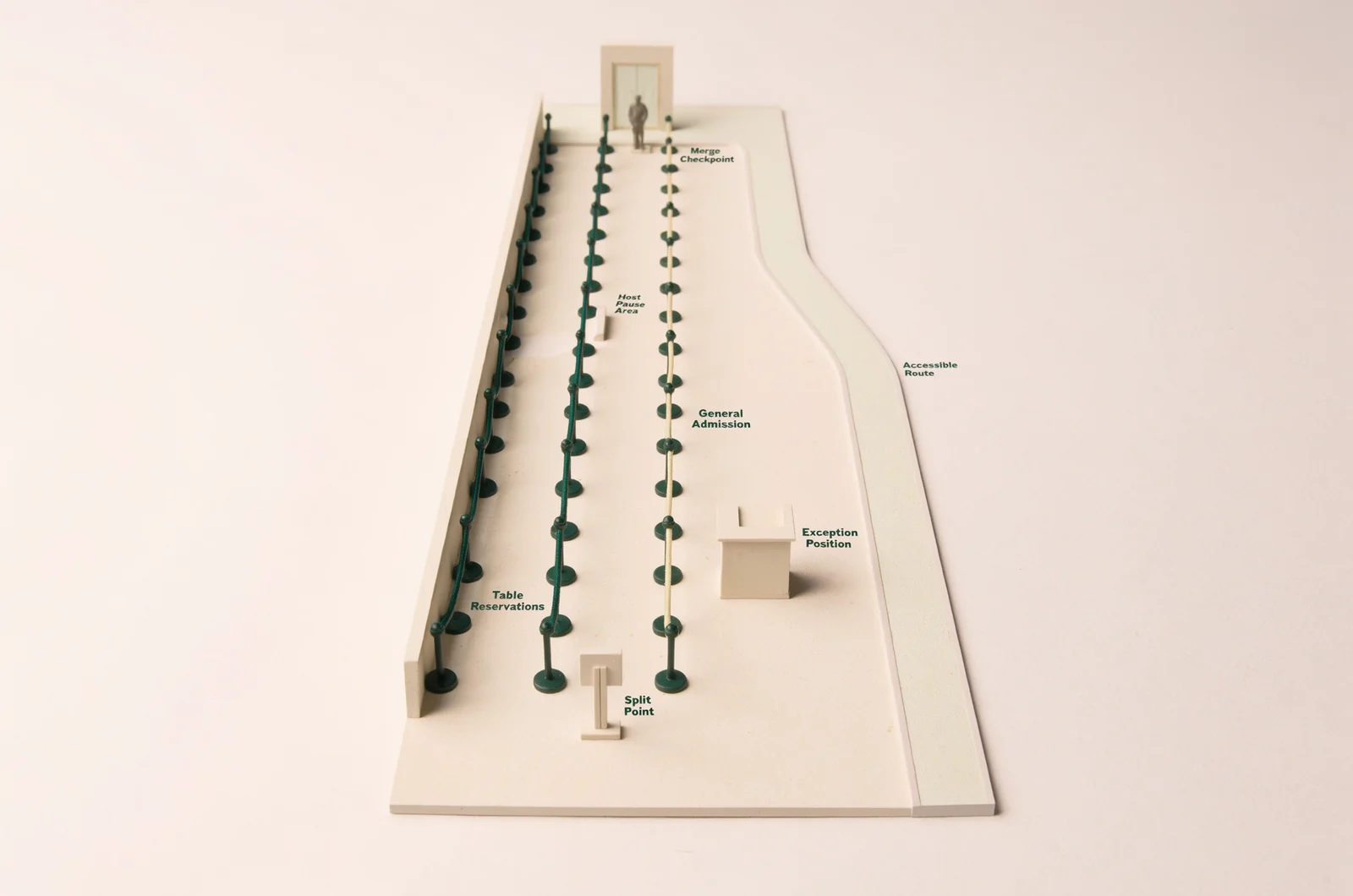
Place the first sign where arrivals can still choose a path. A sign beside the scanner arrives too late for someone already deep in the wrong queue. Use plain labels such as table reservations and general admission, with any other eligible ticket categories stated clearly.
The table host needs a position where a group can pause without blocking guests approaching the entrance. Leave room for reservation lookups and a separate place for longer discussions.
Both queues should have visible routes forward. Avoid a layout where table guests must cross the GA line repeatedly to reach a host, complete checks, or meet an escort.
A faster check-in flow depends on those handoffs as much as the scan itself. Trace the guest’s route from the sidewalk to the table during the pre-opening walkthrough.
Include an accessible arrival route in that walkthrough. Guests who need assistance should have a clear way to reach staff without negotiating barriers.
Finish by standing at the back of each queue. Check whether a first-time guest can identify the correct lane and see where to ask a question.
How many staff does each lane need?
Each lane needs enough staff for its arrival workload, with clear coverage for verification, required screening, and exception handling.
Headcount alone can hide the problem. A table host who verifies bookings, collects balances, answers promoter calls, and escorts parties will leave the lane unattended during some of those tasks.
Assign ownership for each job:
- A greeter sorts arrivals before they join a queue.
- Check-in staff verify the relevant ticket or reservation.
- Screening staff complete the venue’s required checks.
- A designated resolver handles disputed records and approvals.
These are responsibilities, not a fixed staffing ratio. At a quieter entrance, one person may cover compatible tasks. During a peak, divide work that repeatedly pulls someone away from the active lane.
For a hypothetical planning example, suppose a position processes one guest every 30 seconds. Its theoretical capacity is 20 guests in 10 minutes. If 24 arrive during that interval, the backlog grows by four even before interruptions.
Use your measured processing times rather than that example when scheduling. Mobile ticket scanning practices can help identify avoidable work at the verification position.
A useful staffing estimator would accept arrivals per interval, observed processing time, and exception frequency, then flag intervals where demand exceeds capacity. Treat its result as a starting point for the door lead’s staffing review.
What happens when members of a table party arrive separately?
Check in each arriving guest against the reservation’s remaining allowance, using a pre-agreed rule for entry without the booking holder.
A reservation for a group should not become unrestricted entry for anyone who knows the holder’s name. Define how staff confirm companions and who can authorize additions.
Decide whether the booking holder must arrive first. Some operating arrangements depend on that person confirming payment or the party list. If that is your rule, communicate it before the event rather than introducing it at the rope.
The record should distinguish expected guests from admitted guests. Staff need to know how many places remain after the first part of a group enters. A second host should not have to reconstruct the count from memory or a separate message thread.
When a VenueStack table party arrives in stages, use the reservation and guest records as the reference for each check-in. Agree how staff will record arrivals before opening.
Avoid marking the entire party as present when only the holder has arrived. Keep late companions at the host position until staff confirm their eligibility, then direct them through the same admission checks as the rest of the party.
How should staff redirect GA guests who join the VIP lane?
Staff should explain the lane’s eligibility rule briefly, verify any credible booking claim, and direct the guest to the correct entrance point.
Start with the booking type rather than a judgment about the guest. Someone may have misunderstood a confirmation, followed a friend, or mistaken a guest list benefit for table priority.
A greeter can resolve simple confusion before it reaches the host. If the guest claims a table reservation, check the name or confirmation. If the claim needs discussion, move it to the exception position.
Promoter relationships need the same clarity. A promoter’s message should not change lane eligibility unless the authorized person approves and records the change.
Avoid negotiating upgrades at the shared checkpoint. Any available table purchase needs its own verification and payment process, followed by a clear handoff back to admission.
Tell redirected guests exactly where to go. Pointing vaguely toward a long line invites another conversation with the next member of staff.
What should the host do when a reservation cannot be found?
Move the lookup to a designated exception position and keep the active lane available for guests whose records are ready.
First check the event date, booking holder’s name, confirmation details, and booking channel. A screenshot can help locate a record, but staff still need to establish what it represents and whether it has already been used.
Assign one person to own the unresolved case. The guest should know who is handling it, while other staff continue processing arrivals. Give that resolver a clear route to someone authorized to approve admission or correct the booking.
Avoid creating a replacement reservation immediately. That can complicate the original payment, guest count, or table allocation if the first record later appears.
Connectivity problems also need a defined response. Keep the fallback procedure available to both lanes, including who can authorize admissions while records are unavailable and how those admissions will be reconciled.
Review QR code check-in failures when preparing that procedure. A stalled device and a genuinely missing booking require different decisions.
Record the reason for each exception. After the event, separate typing errors, duplicate records, payment disputes, and connectivity failures so the next briefing addresses the actual cause.
What if the VIP queue grows while general admission keeps moving?
The door lead should identify the stalled stage and move suitable help there, while preserving coverage for both lanes.
Queue length alone does not show which lane needs another scanner. A table queue may be waiting on reservation checks, payment approval, screening, or escorts. Adding verification staff will have limited effect if the floor cannot receive the parties already cleared.
Ask the table host what is waiting and why. Then assign help to that task. If escorts are unavailable, contact the floor lead. If one complicated booking is holding the host, move it to the resolver.
Use the shared checkpoint sequence consistently while the problem is addressed. Repeatedly stopping GA without explanation can create a second backlog.
Capacity holds require a separate decision. A table reservation should not be used to override the venue’s applicable occupancy limit. Follow the established hold procedure and have one person communicate the status to both lanes.
When entry resumes, the door lead should control the release. Letting several waiting parties advance together can overwhelm the checkpoint or leave the table host unable to track who has entered.
Which numbers show whether separate lanes are working?
Measure waiting, processing, and exceptions for each lane, then compare similar arrival periods before changing the staffing plan.
Start with clearly defined timestamps. Queue-entry time measures when waiting begins. Check-in time shows when verification happens. Admission time marks entry, while seating time captures the final table handoff.
A scan timestamp alone cannot establish total waiting time. If queue entry is not recorded, use periodic manual observations and label those measurements accordingly.
Review these measures by lane and arrival interval:
- Arrivals and completed admissions.
- Typical waits and the longest observed waits.
- Time spent verifying each guest or party.
- Exceptions requiring a supervisor.
- For table guests, the delay between admission and seating.
State whether a measure counts people or parties. One table booking can represent several arriving guests, so reservation totals cannot substitute for a guest count.
VenueStack’s check-in and attendance reporting can contribute to the review. Pair the available records with door observations instead of assuming every stage has a timestamp.
Compare nights with similar arrival patterns and record staffing changes alongside the results. An improved VIP wait carries limited value if GA waiting grows sharply during the same period.
Turn the review into the next shift’s briefing: eligibility, merge control, exception ownership, and the period that needs extra coverage. Assign a named owner to each change before doors open.