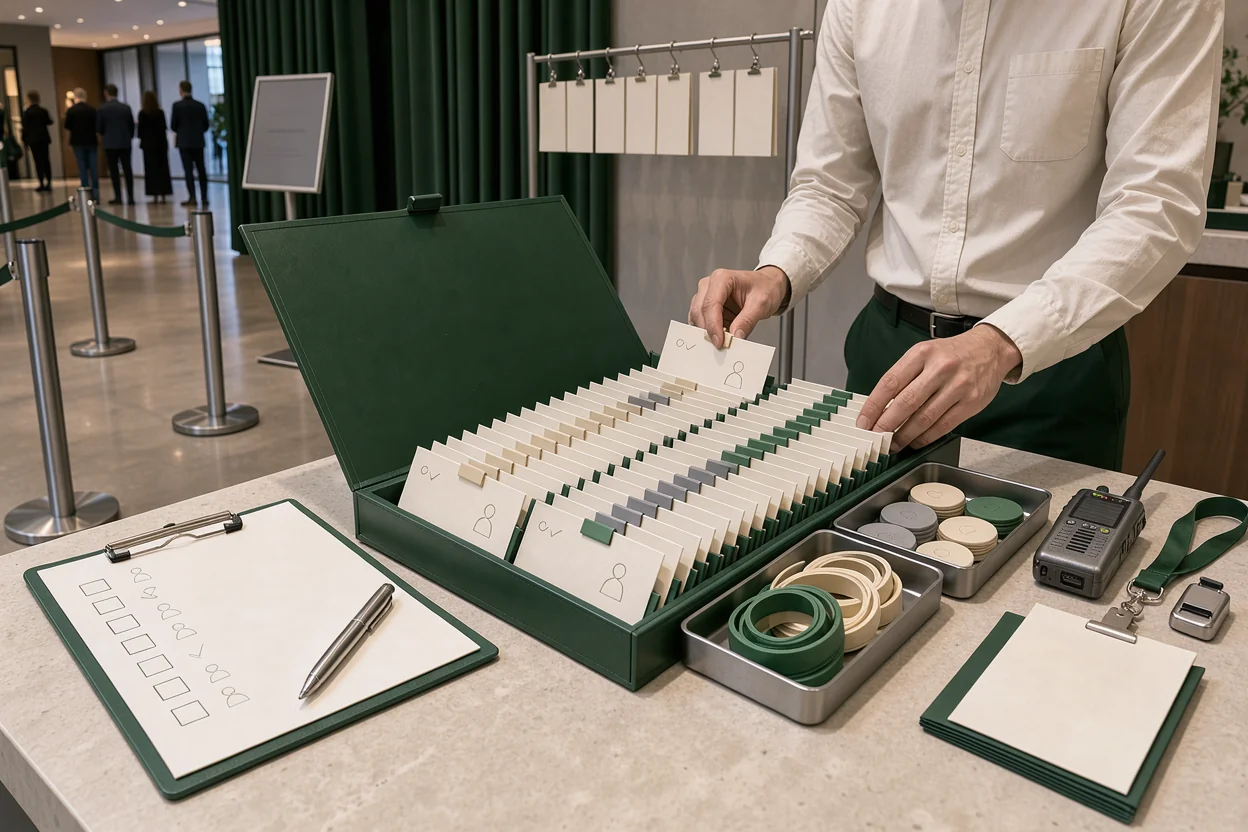
For a nightclub or lounge operator, calculating food and beverage minimum buyout pricing starts with what the displaced night would contribute after its avoidable costs. From there, build a minimum that covers the private event’s costs and meets your margin target.
Have settled sales reports, payroll estimates, supplier costs, and the proposed access hours ready. The calculation should produce three clear figures: the revenue you need to replace, the required food and beverage spend, and the client’s estimated total bill. Check each separately before releasing the quote.
Set the buyout’s boundaries
Define exactly what the private event removes from sale. A full buyout might block the main room, terrace, and tables for an entire evening, even when guests attend for only three hours.
Write down:
- The spaces reserved exclusively for the client.
- Setup access, guest arrival, service cutoff, and departure times.
- Cleanup hours and when public trading can resume.
- Expected attendance and the agreed service format.
- Food and drinks that count toward the minimum.
An F&B minimum is the agreed amount of eligible food and beverage spend. A room rental fee, tax, gratuity, or service charge needs its own treatment in the quote.
For the calculation below, assume one hypothetical lounge buyout with 120 guests. Its access and reset schedule displaces a full Friday night. All figures are illustrative planning assumptions.
Set these details within your private event booking workflow before pricing. A later change to access hours can change labor and displaced revenue.
Verify the closure window with the person responsible for reopening the venue. Price every affected trading hour, including hours lost to setup.
Rebuild what the regular night would contribute
Estimate the contribution the venue gives up by accepting the buyout. Contribution means revenue remaining after the costs attached to that trading activity, before shared overhead such as rent.
Separate tickets, tables, and bar sales
Use several comparable nights to build the baseline. Match weekday, season, opening hours, and event format.
The hypothetical Friday normally produces:
- $3,000 in ticket and cover revenue.
- $6,000 in actual table food and beverage sales.
- $5,000 in other bar sales.
Total revenue is $14,000, excluding taxes and pass-through amounts.
Use actual table spend, rather than adding advertised minimums to POS sales. If the $6,000 already includes drinks purchased by table guests, those drinks must stay out of the other bar total.
Reconcile your door revenue mix across presales and door payments. Remove refunds, and treat deposits applied to checks as part of those checks.
VenueStack’s event reporting can supply ticket and table totals. Match them against POS checks and payment settlements to resolve revenue report gaps before choosing the baseline.
Subtract the costs the closure avoids
Suppose canceling the regular night avoids:
- $2,800 in food and beverage product costs.
- $2,000 in hourly labor.
- $1,200 in entertainment, contracted security, and selling costs.
Those costs total $6,000. The regular night’s contribution is therefore:
$14,000 − $6,000 = $8,000
Check each expense against the cancellation scenario. Exclude costs that remain identical under either booking, such as an unchanged manager’s salary. Record any additional cancellation penalty under the private event.
Your baseline is ready when every revenue stream appears once and every deducted expense would disappear if the regular night did not run.
Cost the private event from setup through reset
Build the buyout’s cost estimate from its own staffing and service plan. A private event may need fewer door staff but more servers, setup labor, or kitchen hours.
For the hypothetical lounge, budget these event-specific amounts:
- $2,400 for staff across preparation, service, and breakdown.
- $600 for contracted security.
- $400 for additional cleaning and resetting the room.
- $200 for cancellation charges triggered by closing the public event.
- $300 as a contingency allowance.
The total is $3,900. These are lump-sum costs for this event, separate from shared venue overhead.
Build payroll from roles, hours, and loaded hourly costs. Include setup and cleanup, plus overtime or agency costs where your staffing plan requires them. Keep employee payroll and contracted services separate so security is counted once.
Next, estimate the costs that rise with F&B revenue. Assume product costs equal 28% of eligible sales and retained payment-processing costs equal another 2%. The combined variable cost rate is 30%.
Use the proposed menu and beverage mix to test that assumption. A champagne-heavy reception can have different economics from a limited cocktail menu.
Verify that each cost appears either in the $3,900 event budget or in the 30% variable rate. Keep the contingency visible so it can be compared with actual spending afterward.
Calculate the minimum and check the margin
Calculate two floors for the buyout: one that replaces the displaced contribution and another that meets your chosen event margin.
Replace the regular night’s contribution
With no separate rental revenue, use:
Replacement floor = (displaced contribution + event-specific costs) ÷ (1 − variable cost rate)
For this example:
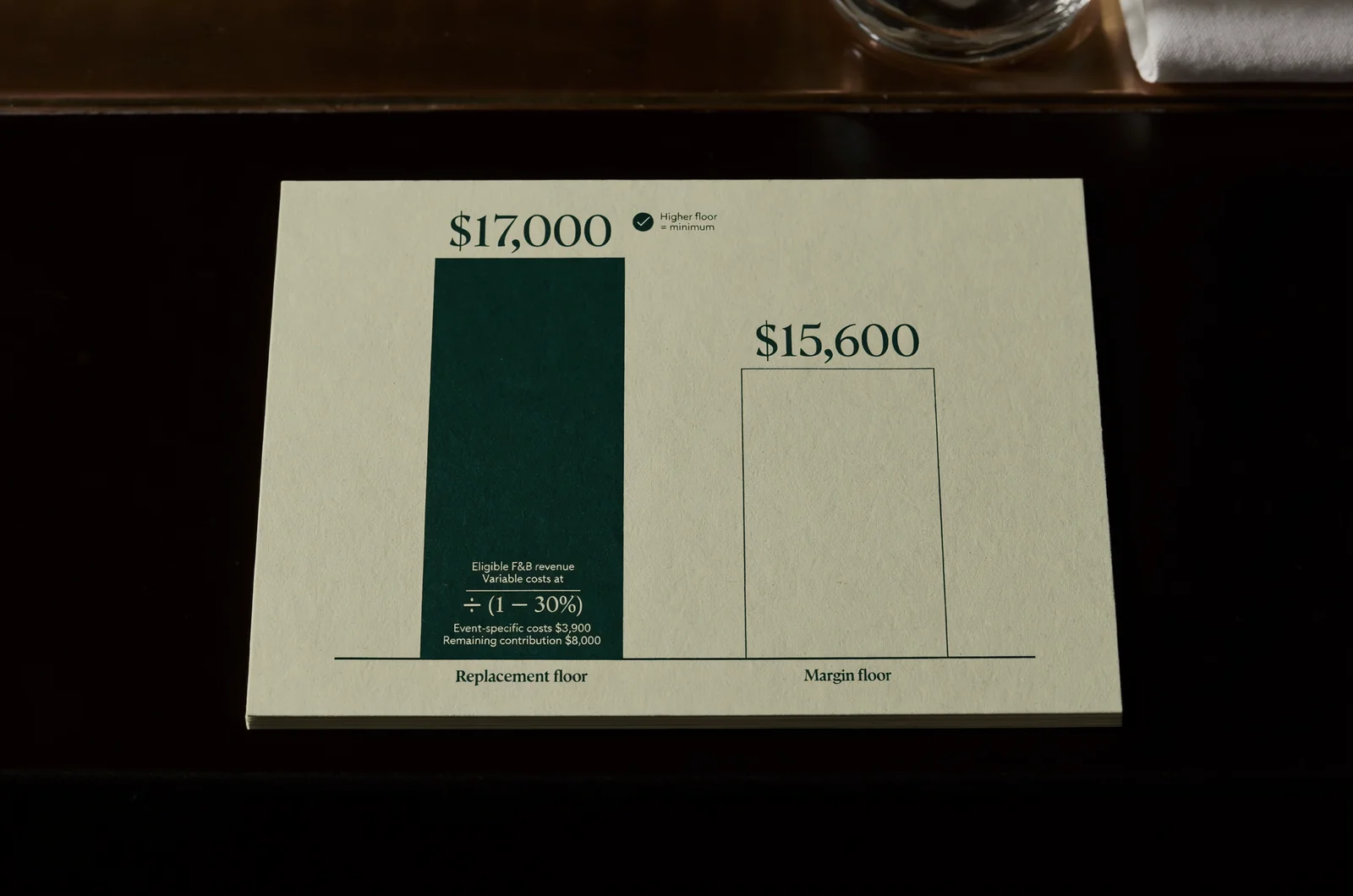
($8,000 + $3,900) ÷ (1 − 0.30) = $17,000
Adding $8,000 and $3,900 alone would underprice the event. The resulting $11,900 would still need to pay for food, beverages, and processing.
Check the $17,000 result backward:
- Eligible F&B revenue: $17,000.
- Variable costs at 30%: $5,100.
- Event-specific costs: $3,900.
- Remaining contribution: $8,000.
The buyout now replaces the regular night’s contribution before shared overhead.
Apply the venue’s contribution margin target
Suppose the operator also requires a 45% event contribution margin. This is a hypothetical management target, measured after the costs above and before shared overhead.
Use:
Margin floor = event-specific costs ÷ (1 − variable cost rate − target contribution margin)
$3,900 ÷ (1 − 0.30 − 0.45) = $15,600.
Choose the higher floor. The replacement calculation requires $17,000, so that becomes the quoted F&B minimum. At that spend, contribution is $8,000 ÷ $17,000, or approximately 47.1%.
A margin-only quote of $15,600 would meet the percentage target while leaving less contribution than the displaced night.
If the variable cost rate and target margin total 100% or more, this formula cannot cover positive event-specific costs. Rework the assumptions before quoting.
A useful buyout calculator would accept these inputs and guest count, display both floors, flag invalid percentages, and return the higher minimum with its implied spend per guest.
Test the spend against guests and the date
Check whether the calculated minimum fits the proposed guest experience and the value of the displaced date.
Translate the minimum into a service plan
At 120 guests, a $17,000 minimum requires average eligible spend of approximately $141.67 per guest. At 80 guests, it requires $212.50.
Build a sample menu and beverage plan at the expected attendance. Check whether its quantities, package prices, and service hours can reasonably support that spend.
If the client’s proposed package reaches only $12,000, identify the $5,000 gap before sending a quote. Discuss a different menu, shorter closure, separate rental charge, or alternative date. Keep the contribution test attached to each revision.
Check last year’s comparable night
Compare the baseline with last year’s corresponding weekday and the same calendar occasion. A holiday, major event, or unusually strong booking can make a Friday unsuitable as an ordinary-night comparison.
Use the same definitions for sales, refunds, and attendance. Consistent event performance metrics make the comparison easier to audit.
Adjust documented changes, such as current menu prices or reduced opening hours. Record the reason beside the adjustment.
Finally, test a less favorable cost assumption. If the variable rate rises from 30% to 35%, the replacement floor becomes $11,900 ÷ 0.65, or approximately $18,308. Resolve that exposure through pricing, purchasing, or menu scope before promising the $17,000 minimum.
Make the quote match the calculation
Translate the buyout minimum into terms the client and event team can both use. Before sending a binding quote or taking payment, confirm the date, scope, and internal approval.
Separate the minimum from the estimated total bill
State the $17,000 eligible F&B minimum and list the food and beverage purchases that count toward it. Show any rental fee, service charge, gratuity, tax, or optional production cost separately under the venue’s approved billing rules.
The internal calculation above assumes those additional amounts do not fund the required contribution. If you plan to count a retained charge as revenue, rebuild the model with its associated costs.
Include the access schedule, attendance assumptions, menu basis, and quote expiry. Identify who can authorize changes and when revised pricing is required.
Check the client-facing totals against the internal estimate. A headline minimum without its additional charges leaves the client with an incomplete budget.
Explain deposits, shortfalls, and changes
If the agreement credits a deposit entirely toward the pre-tax F&B minimum, a hypothetical 25% deposit would be $4,250. The remaining minimum would be $12,750 before separate charges.
The deposit is an advance payment toward that obligation. Count it once when reconciling the balance.
Document payment dates, cancellation terms, changes in attendance, overtime, and how any unspent minimum is settled. Align the quote with your card on file deposit policy.
Test the paperwork with a sample final bill. Confirm that the booking team and finance team calculate the same deposit credit, shortfall, and remaining balance.
Answer the pricing questions before signing
Resolve these questions while the minimum is still being negotiated.
Does a separate room fee reduce the F&B minimum?
A retained room fee can help cover the required contribution. Subtract that revenue from the replacement formula’s numerator, then add any costs needed to deliver the rental.
Recheck the margin against combined eligible F&B and rental revenue. The earlier margin formula assumed rental revenue was zero, so it needs updating when the charging structure changes.
Keep the rental fee separate from eligible consumption on the quote.
Should a quiet weekday have the same minimum?
Recalculate it using that weekday’s displaced contribution. Keep the event’s actual service costs in the estimate.
A quieter date may justify a lower minimum, but a demanding production or staffing plan can still create substantial costs. Change the assumptions individually so the revised price has a clear basis.
Verify the alternative date against comparable weekday reports.
What happens if guests spend less than the minimum?
Follow the settlement terms documented in the agreement. If eligible consumption reaches $15,500 against the example’s $17,000 minimum, the difference is $1,500.
Show consumption and any agreed shortfall charge distinctly on the final statement. Have finance confirm the billing treatment before the quote is issued.
Also state how spending above the minimum is authorized. Give the event lead a named client contact and an agreed approval process before service begins.
Reconcile the event and update the next quote
Compare the completed buyout with the assumptions that produced its minimum. Close the event record with eligible sales, deposit credits, product costs, actual labor, contracted services, and any shortfall settlement.
Use VenueStack’s sales and attendance reporting alongside POS consumption and payroll records. Check whether attendance matched the plan and whether access or cleanup ran longer than quoted.
For example, if the $17,000 event incurs $5,600 in variable costs and $4,200 in event-specific costs, its contribution falls to $7,200. That is $800 below the intended replacement contribution.
Find the cause before changing future prices. Extra staff hours require a different correction from an underestimated beverage cost or an unbilled extension.
Replace the contingency allowance with actual expenses during reconciliation. Keep the original quote assumptions beside the final figures so the next operator can follow the calculation.
Before pricing the next comparable date, update the relevant labor hours, product mix, or service limits and rerun both minimum floors.