Your New Years Eve event ticketing strategy should connect the money you need upfront with the guests your venue can accommodate. Build it around a fixed inventory, a contribution target, and release rules the reservations manager and door supervisor can both follow.
The finished plan should answer four questions: how many admissions can you sell, what must each tier earn, when must cash arrive, and how will staff verify each booking? Gather your final floor plan, entertainment contracts, staffing budget, payment costs, and previous event reports before setting prices.
The example below uses one hypothetical venue throughout. All amounts are in U.S. dollars, with taxes and gratuities excluded.
Set the guest limit and the cash deadline
Start your NYE inventory with the confirmed guest allowance for the actual event layout. Account for staff, performers, restricted areas, and production requirements when confirming that allowance. Resolve uncertainty before publishing tickets.
Suppose your final layout allows 400 guests. Reserve 20 places for complimentary admissions and operational holds. Allocate ten tables with six included guests each.
Your individual ticket inventory is:
400 guest places − 20 reserved places − 60 table guests = 320 tickets
Every sales channel must draw from those allocations. A promoter’s allocation uses the same room inventory, and a table booking consumes six guest places even if only the lead guest has provided a name.
Use the same figures in your floor plan, booking setup, and pre-sale capacity checks. Verify that selling all available tickets and tables would admit no more than 400 guests.
Then set a cash deadline against actual payment obligations. If entertainment payments fall due on December 15, calculate what must be available by that date.
Use settled receipts after payment costs, refund reserves, and other committed uses. Check payout timing separately from the date a guest buys.
Assign one manager authority to release holds. Record the quantity, reason, and revised inventory whenever an allocation changes.
Calculate the contribution each ticket must earn
Price your NYE tickets against contribution: the money left after direct costs that can cover event overhead and profit. Gross sales alone will overstate what you have available.
Build the budget from costs you can identify
For the hypothetical venue, assume:
- Entertainment costs $12,000.
- Additional staffing and security cost $5,000.
- Production, allocated overhead, and other event costs total $3,000.
- The desired operating profit is $5,000.
- Forecast beverage contribution is $6,000 after direct beverage costs.
- Variable costs average $10 per individual ticket.
The required ticket contribution is:
$20,000 event costs + $5,000 profit target − $6,000 beverage contribution = $19,000
With all 320 individual tickets sold, the required average ticket price is:
($19,000 ÷ 320) + $10 variable cost = $69.38
That is the average across the complete ticket mix. An early ticket can sit below it if later sales bring the weighted average above it.
Build beverage contribution from expected sales less drink costs and other directly related expenses. Include table spending once. A deposit credited toward a table bill is part of that bill.
Check what happens when the room sells slowly
The $69.38 floor assumes all 320 tickets sell and the beverage forecast holds. Lower attendance changes both sides of the calculation.
Run a second budget with fewer admissions, fewer tables, and a lower ticket yield. Keep contracted entertainment costs unchanged unless the contract actually permits an adjustment.
A useful planning calculator would accept capacity, ticket quantities, prices, direct costs, and table sales. It would return weighted ticket yield, forecast contribution, and the gap against your cash deadline.
Approve prices only after the lower-sales scenario shows how much money the venue would need to cover any shortfall.
Divide ticket inventory into capped releases
Allocate your 320 individual admissions before opening sales. Each release needs a quantity, price, closing condition, and contribution calculation.
Give the early release a specific job
Suppose you want the first release to generate $3,000 in ticket contribution. At a $60 price and $10 variable cost:
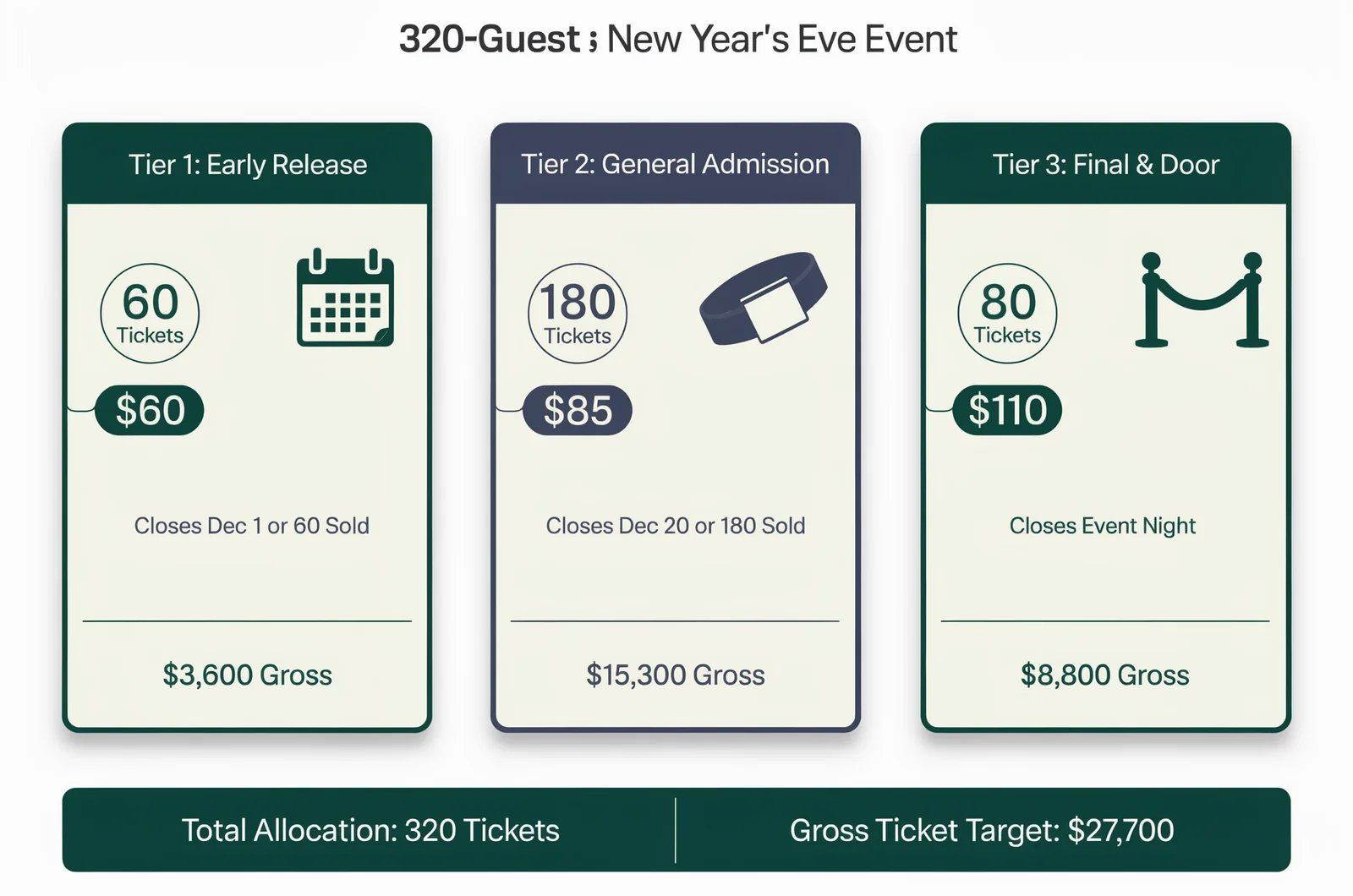
$3,000 ÷ ($60 − $10) = 60 early tickets
Those tickets collect $3,600 gross and contribute $3,000 under the example’s assumptions.
Compare early bird pricing models against your payment calendar, then select a hard quantity cap. Extending a discounted allocation means recalculating the remaining revenue requirement.
Allocate the remaining admissions
Reserve 80 tickets for the final release, then assign the balance to standard admission:
320 − 60 early tickets − 80 final tickets = 180 standard tickets
The hypothetical mix is:
| Release | Ticket quantity | Price per ticket | Gross ticket revenue |
|---|---|---|---|
| Early bird | 60 | $60 | $3,600 |
| General admission | 180 | $85 | $15,300 |
| Final release | 80 | $110 | $8,800 |
At full sale, ticket revenue is $27,700. The weighted average is $86.56, and ticket contribution is $24,500 after the modeled $3,200 in variable costs.
Now remove all 80 final-release sales. Ticket contribution falls to $16,500. If beverage contribution also falls to $4,500, the event produces $1,000 above its $20,000 event costs. It misses the $5,000 profit target.
Use that result to decide whether to reduce commitments, revise allocations, or accept the exposure before publishing the release schedule.
Set table minimums and separate deposits from revenue
Build VIP table pricing around the space, included admissions, and beverage contribution expected from each booking. State precisely what the guest is purchasing.
For the ten-table example, suppose tables must generate $6,000 in beverage contribution. At an assumed 50% contribution margin, the required beverage sales are:
$6,000 ÷ 0.50 = $12,000
Across ten tables, that means a $1,200 minimum per table. This forecast requires all ten tables to sell and each minimum to be collected. Adjust the margin and booking count to match your own records.
If each table pays a $600 deposit credited toward its minimum:
- The ten deposits collect $6,000 before the event.
- The remaining minimum balances total $6,000.
- Total minimum spending is $12,000.
Collecting a deposit changes payment timing. It does not increase the agreed minimum.
Write the booking terms before accepting payment. Specify included guest count, arrival deadline, deposit credit, qualifying purchases, remaining balance, cancellation treatment, and any separately charged items.
Check your event table rules against those terms. Keep the same wording in checkout, confirmations, and staff instructions.
Verify a sample booking with the reservations manager: six included guests should consume six places, the deposit should have a clear credit, and the remaining balance should be identifiable.
Schedule releases against sales pace and cash needs
Give each NYE release a trigger that staff can verify. A workable sample calendar closes early bird on December 1 or at 60 sales, standard admission on December 20 or at 180 sales, and final admission when its 80-ticket allocation sells.
Those dates are planning choices. Move them to fit your contracts and your own sales history.
Separate released stock from door stock
Decide whether the final 80 tickets remain available online through event night or whether some become walk-up inventory. Document the transfer between channels.
Your presale ticket revenue mix should reflect how much uncertainty the business can carry. A venue with substantial advance payments may need more presales than one with fewer upfront commitments.
Before changing a release, record:
- Tickets sold and admissions still available.
- Gross receipts and settled cash.
- Table deposits collected and balances outstanding.
- Contribution forecast at the current sales mix.
Respond to a shortfall with a defined action
If sales trail the plan, check the purchase path first. Confirm that the event is visible, checkout works, inclusions are clear, and payment failures reach someone who can act.
Then decide whether to change promotion, release timing, or spending. Recalculate the forecast before adding discounted inventory.
Keep scarcity messages tied to actual allocations. When a release sells out, close it and open the next approved release.
Check settled cash against the December 15 obligation separately. A strong sales forecast cannot pay a bill if the payout arrives afterward.
Test the purchase path and rehearse the door
Run a complete booking rehearsal before promoting the event widely. The test should show that a guest receives the right entitlement and staff can recognize it.
Buy each admission type and inspect the record
Complete the platform’s supported test process for an early ticket, a standard ticket, and a table booking. Inspect the guest confirmation, event date, local arrival time, inclusions, and payment record.
For a group booking, establish whether guests share one booking code or receive individual tickets. Check how staff record partial arrivals and how they identify the number still expected.
If you manage ticketing and table bookings in VenueStack, enter the same allocations used in your planning sheet. Your unified ticket and table sales page should make the difference between admission and a table reservation clear.
Ask a staff member who did not build the event to explain each purchase from its confirmation. Correct any ambiguity before launch.
Rehearse exceptions as well as scanning
Test duplicate presentation, a guest without a confirmation, a table arriving in separate groups, and a payment marked incomplete.
Assign responsibility for each exception. Door staff need a clear route to the supervisor who can approve a correction.
Provide separate handling for routine admissions and booking problems where space and staffing allow. Prepare charged devices, connectivity checks, and a documented fallback process that preserves a shared admission count.
Track occupancy separately from sales. Define how exits and re-entry are recorded, then test that process.
Time a short rehearsal and use the result to assess staffing for your expected arrival window. Confirm that every entrance follows the same admission and exception rules.
Reconcile the night against the original budget
Close the NYE event with separate views of money, attendance, and contribution. Each answers a different operating question.
Use VenueStack’s sales and attendance reporting alongside payment settlement records and bar reports. Compare tickets issued, tickets refunded, paid admissions, complimentary admissions, table attendance, and unresolved exceptions.
For tables, match each deposit to its credited bill and remaining payment. Remove duplicate counting before totaling revenue.
Calculate final contribution using actual costs. Compare the $10 ticket-cost assumption and beverage margin with what the night produced. Record any uncollected minimums separately from completed sales.
Measure performance against the original plan:
- Weighted ticket yield against the planned $86.56.
- Settled cash by each supplier deadline.
- Table sales and collected minimums against forecast.
- Attendance and arrival patterns against staffing.
- Actual operating profit against the $5,000 target.
Save the original release quantities beside the final results. Before planning the next holiday event, document which allocation or cost assumption needs to change.
Resolve ticket changes before guests arrive
Should you oversell because some guests will stay home?
Keep sales within the confirmed guest allowance. Forecast no-shows for purchasing and staffing decisions, while preserving capacity for every guest entitled to admission.
Can unsold table places become general admission?
Review the floor plan and guest allowance first. A table area may need a different setup before it can accommodate additional standing guests. Update the booking inventory and staff instructions before releasing any places.
What should happen when a table guest already bought a ticket?
Apply a written policy for refunds, transfers, or upgrades. Confirm whether the table package already includes that person’s admission, then correct both the booking and the capacity record.
Should you discount the last tickets on December 31?
Calculate the contribution from the proposed price and check how you will handle earlier purchasers. If you proceed, cap the allocation, state the terms, and give the door team the same information guests receive.